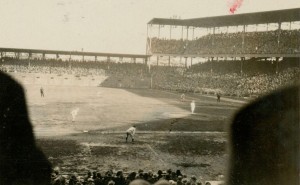
It had been a long, tense afternoon for the thousands hunkered around scratchy radios. After a wrenching scare in the seventh inning, the Cardinals led 3-2 with two outs in the bottom of the ninth at Yankee Stadium. Babe Ruth was on first, Lou Gehrig on deck.
Ruth bolted for second, but catcher Bob O’Farrell’s throw reached second-baseman Rogers Hornsby in time. The Bambino, who averaged only eight steals a season, was out. Just like that, the Cardinals were 1926 world champs.
“It was like a city-wide detonation,” the Post-Dispatch said of the next moment. Cheers exploded all through the city and suburbs. People clanged cowbells, blew up fireworks and honked vehicle horns. Cars dragged pots, strings of cans — anything that would make a racket.
The celebration began at 3:20 p.m. Sunday, Oct. 10, and roared well past midnight.
Cardinals fans would savor 10 more World Series championships, but 1926 was the glorious first. The franchise traces to the original Browns of the long-dead American Association in 1882. Purists will note that those Browns played in four “world series” in the 1880s — one win, two losses and one declared a tie. Today’s World Series dates to 1903, minus 1904, when it wasn’t played.
The team joined the National League in 1892, became the Perfectos in 1899 and the Cardinals one year later. Legend has it that a sportswriter overheard a female fan compliment the team’s “cardinal” red uniforms. (The St. Louis Browns of the American League first played here in 1902 and became the Baltimore Orioles in 1954.)
In the National League, the Cardinals never finished better than third until winning the 1926 pennant. Bookies rated them narrow underdogs in the series against the Yankees, who hadn’t amounted to much, either, until the early 1920s and Ruth.
St. Louis had three street celebrations that fall, first when the Cardinals clinched the pennant Sept. 24, and 10 days later with a parade down Washington Avenue when the team returned home for Game 3 of the series.
People without radios listened to Game 7 in neighbors’ houses and theaters. When play-by-play announcer Graham McNamee declared victory over KSD, the local telephone exchange was quickly swamped with 5,000 calls. (Back then, 10,000 in an hour was busy.) Thousands headed downtown in cars, streetcars and buses.
On joyously gridlocked streets, fans festooned cars and themselves with streams of red crepe paper. Previewing fashions that endure, one woman had a redbird painted on her cheek. Two men slathered their faces in red.
In the madness, two teenagers died. Emil Lueck, 15, was struck by car while throwing streamers on Lee Avenue. William Troll, 17, was riding on an auto running board when his head was hit by a passing streetcar on Jefferson Avenue.
At 5:10 p.m. the next day, the Pennsylvania Railroad’s “American” pulled into Union Station. All but a few of the players managed to slip away in the train yard, petrifying the advance men who were promoting a celebration that night at Sportsman’s Park.
Hornsby, who doubled as team manager, switched trains for Texas and his mother’s funeral. Grover Cleveland Alexander, the pitcher who won two games and got the Cardinals out of their final-game jam, corralled 10 teammates for the 30,000 fans at the stadium.
A stage with a loudspeaker was set up, but nobody could hear a word any player said. After fans surged onto the field, Mayor Victor Miller switched off the stage lights.
The players again disappeared through the crowd. Fans didn’t figure it out for almost 30 minutes.
Grover Cleveland Alexander, hero with a hangover
Grover Cleveland Alexander grew up on a farm in central Nebraska and broke into major-league baseball in 1911 as a pitcher for the Philadelphia Phillies. He was with the Cubs when he left for France to serve in an artillery unit during World War I.
He returned partly deaf, suffering bouts of epilepsy and too fond of alcohol. Exasperated Cubs management cut him in June 1926 when he was 39. Cardinals player-manager Rogers Hornsby thought Alexander had some good pitches left.
Alexander, nicknamed “Old Pete,” won 11 games to help his new team win the National League pennant. During the World Series against the Yankees, he pitched two complete-game victories, winning games two and six, both in Yankee Stadium.
The next day, he threw four pitches into legend, part of it still disputed.
In the seventh, the Yankees loaded the bases against Cardinals starter Jesse Haines. Alexander was in the bullpen. He probably was groggy from a hangover. Hornsby summoned him to the mound.
On a 1-1 count, Tony Lazzeri bombed a ball just foul. Alexander then struck him out and finished the game.
Afterward, Alexander insisted that he wasn’t drunk or hung over and held a grudge against Hornsby, who had told reporters after the game, “Alex can pitch drunk better than any other pitcher sober.”
Alexander won 21 games for the Cardinals the following season, but got out of baseball in 1930 after an 0-3 start back with the Phillies.
He was voted into the Hall of Fame in 1938, but life after baseball wasn’t so kind. Alexander pitched in small-time exhibitions and even worked a small variety show in New York.
He was living on a $100 monthly baseball pension when he died at age 63 in 1950 in a rented room in St. Paul, Neb., near the old family farm. The American Legion organized his funeral. The Cardinals paid for it.