PHOENIX (AP) — The coronavirus pandemic stopped work for nearly a month at the California farm where Luis earns $80 a day picking tomatoes, but that didn’t stop him from sending $800 to family in Mexico.
The money had traveled far by the time he was back at work in June. It kept his family fed, funded his father’s hernia operation and paid for other medical expenses.
Early in the pandemic, experts predicted that migrant workers in the U.S. like 32-year-old Luis — who didn’t want his last name used for fear of losing his job and being deported — would wire home less money as the virus hammered the American economy. But those predictions didn’t materialize for workers from Mexico, who have sent home huge amounts of money, called remittances.
In August, their payments amounted to $3.57 billion, according to the Bank of Mexico, the second-highest level on record for a single month and 5.3% above August 2019. Payments in the first eight months of 2020 ballooned to $26.4 billion, up 9.4% compared with the same period last year.
The enormous sums of money moving south, most through electronic transfers, have puzzled some economists, who say their original forecasts underestimated the strength of “human networks” between Mexican migrants in the U.S. and their families back home. They also say the rise has been driven by a weakened Mexican peso and the $600-a-week U.S. unemployment benefit that expired at the end of July. Despite that, the surge continued in August.
“We are honestly very surprised at their resilience,” Jonathan Fortun, an economist at the Institute of International Finance in Washington, said about the payments.
Money coming from families in the U.S. has long been a lifeline in Mexico. The payments are critical to low-income families for expenses like food and clothing. They also cover medical needs, pay off debts and fund investments like homes.
In 2019, remittances reached a record $36 billion, according to central bank data — more than what Mexico earned that year from foreign tourism or annual petroleum exports. And they’re on pace to exceed that this year. Most of the money came from the U.S., home to an estimated 37 million people of Mexican origin.
The payments have only become more important. Mexico provides no federal jobless benefits and workers and businesses have received little relief during the pandemic. Between April and June, Mexico’s economy contracted by 17% compared with the same period last year, and in June, a government agency that measures poverty found that 48% of the country wasn’t earning enough to cover a basic basket of food.
For Luis, the logic was simple: As long as his employer — a large California fruit and vegetable grower — kept him in the fields, he would continue sending as much money as he could to Mexico.
“More than anything, for their health,” he said of his family. “So they don’t have to leave (the house) so much.”
He’s sent over $2,000 since April to Tecoanapa, a poor, coastal district of 47,000 in Guerrero state where his parents, eight siblings and 84-year-old grandmother live. Luis says the money orders he’s sent have put him more at ease while he’s nearly 2,300 miles (3,700 kilometers) away during a pandemic.
“With all of this stress,” he said, “instead of reducing the reason to send money, in my case, I tried to help them more.”
In August, the peso lost about 12% of its value against the dollar compared with the same month last year, making remittances go farther. Pia Orrenius, a senior economist at the Federal Reserve Bank of Dallas, says that largely explains the strong numbers.
Also, many Mexican migrants sending money are farmworkers, delivery drivers and construction workers — industries that only briefly or never stopped working during lockdowns.
Orrenius says that’s just part of the story. Mexican workers in the U.S. suffered from restaurant closures and the blow to tourism, she said. And federal data shows that the Hispanic unemployment rate, both foreign-born and American, stands at more than double pre-pandemic levels.
“They were extremely hard hit,” Orrenius said. But government checks and unemployment benefits offered a buffer for those in the country legally, she said, and some of that money may have been sent to Mexico.
Even after those benefits expired, the money kept flowing south.
“It talks about the resilience and the priorities that these types of families” have, said Fortun, the IIF economist.
The pandemic has had unequal economic effects on other Latin American migrants in the U.S. Remittances to Guatemala, Honduras and El Salvador — economies far more reliant on them — plummeted in the spring before rebounding. Mexico’s different experience suggests its workers in the U.S. were better insulated from the initial shocks of the pandemic.
One likely reason is that more Mexican migrants have lived in the U.S. for longer than a decade compared with the overall immigrant population, according to the nonprofit Migration Policy Institute in Washington. Workers with longer U.S. employment histories tend to have more savings, which economists believe Mexican expatriates have tapped to send money home.
Luis is one of them. He says he’s lived in the U.S. without legal status for 13 years and has never returned to Mexico. In May, when his employer sidelined him and other workers for nearly a month, he said he dipped into what he had saved last year to pay his expenses and send money home.
He fears catching the virus as he rides from Fresno to work with two other men and shares bathrooms at the farm. And he thinks about what would happen to his family in Tecoanapa if he couldn’t work.
“There arrived a moment where … I felt so nervous, I couldn’t sleep,” Luis said.
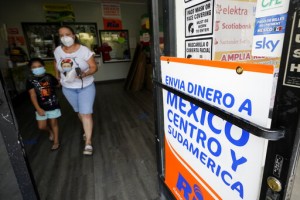
A woman leaves a store offering services to send remittances to Mexico and Central America, Friday, Sept. 11, 2020, in San Diego. Mexican workers have confounded economists by sending home huge amounts of money during the coronavirus pandemic. Experts had predicted that migrant workers would wire less money, known as remittances, as the American economy took a dive. (AP Photo/Gregory Bull)