So you’ll probably want to leave that MAGA hat or “Joe 2020” T-shirt at home.
“The laws are specific to each state, and they are enforced by poll workers,” says Richard Hasen, a political science professor at the University of California, Irvine. “What one can wear, and whether other laws might violate the First Amendment, would have to be determined on a case by case basis.”
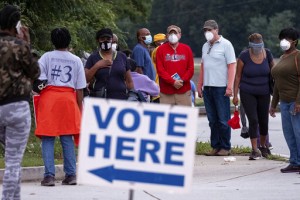
Every state has restrictions on political activities at voting locations. The thinking is that polling places should be free of politicking so that voters can cast their ballots in peace.
Displaying or voicing information for or against any candidate is considered “electioneering” — another word for campaigning. Laws on electioneering at polling locations vary by state. For example, in California and Texas, political attire cannot be worn within 100 feet of a polling place. In Delaware, it’s 50 feet.
“A person may not wear a badge, insignia, emblem, or other similar communicative device relating to a candidate, measure, or political party appearing on the ballot … in the polling place,” Texas law states.
In Iowa, voters can wear clothes or buttons with political affiliations — but they have to leave a polling place as soon as they cast their ballots.
“Campaigning or electioneering of any kind in a polling place is illegal; loitering in a polling place while wearing political items is considered electioneering,” Iowa’s elections website says.
State laws are less clear on wearing clothing with statements such as “Black Lives Matter” that don’t express an opinion about a particular candidate or party.
They can also be prosecuted. In Michigan, for example, someone who displays support for a candidate within 100 feet of a polling place can be charged with a misdemeanor. The interpretation varies based on the poll workers, so the safest bet is to avoid a potentially controversial item.
Given the long lines at many early polling locations, you won’t want to wait for hours to vote only to be turned away at the last minute because of something you’re wearing. Check your state’s elections website for restrictions.
In one case, the Supreme Court weighed in
If you want to fight for the freedom to wear what you want to the polls, you won’t be the first.
In June 2018, the US Supreme Court ruled against a Minnesota law that prohibited wearing political clothing at a polling place on Election Day.
A group of voters sued after being asked to cover up when they went to a polling place wearing T-shirts and pins in support of the Tea Party, the conservative movement.
Minnesota state officials argued the law was in place to avoid voter interference and distraction. But the Supreme Court concluded that while states are free to decide what type of advocacy should be excluded from polling places, the Minnesota law was too broad.
“Casting a vote is a weighty civic act, akin to a jury’s return of a verdict, or a representative’s vote on a piece of legislation,” Chief Justice John Roberts wrote. “It is a time for choosing, not campaigning. The state may reasonably decide that the interior of the polling place should reflect that distinction.”
But Minnesota’s use of the term “political” apparel was overly vague and confusing, Roberts wrote.
“Would a ‘Support Our Troops’ shirt be banned, if one of the candidates or parties had expressed a view on military funding or aid for veterans?” he wrote.