With the global economy in flux due to the coronavirus outbreak, worker protections have been under increased scrutiny. Massive layoffs, especially in the retail, leisure, and hospitality industries, have left millions of Americans without a steady paycheck or benefits. Unfortunately, some of the hardest hit industries also report low union membership rates, making workers even more vulnerable.
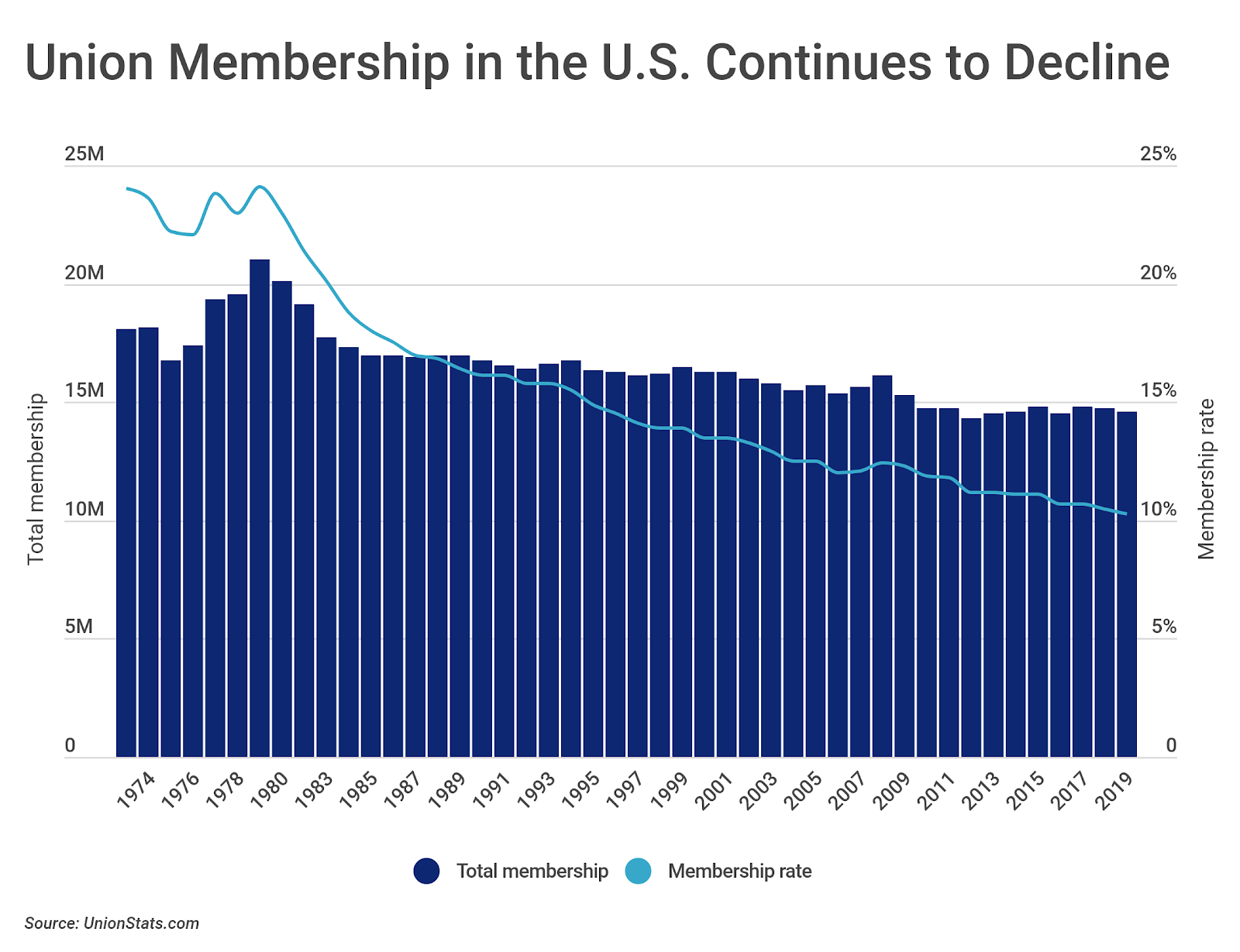
Union membership in the U.S. has declined significantly over the past several decades—a result of more states passing “right-to-work” laws and changes in the composition of the U.S. labor force. Many of the fastest-growing industries have low rates of union participation. In 1979, 24 percent of U.S. employees belonged to a union. By contrast, only 10.3 percent of American workers were union members in 2019. In nominal numbers, union membership accounted for roughly 14.6 million workers in 2019, approximately 6.5 million fewer than the 1979 peak.
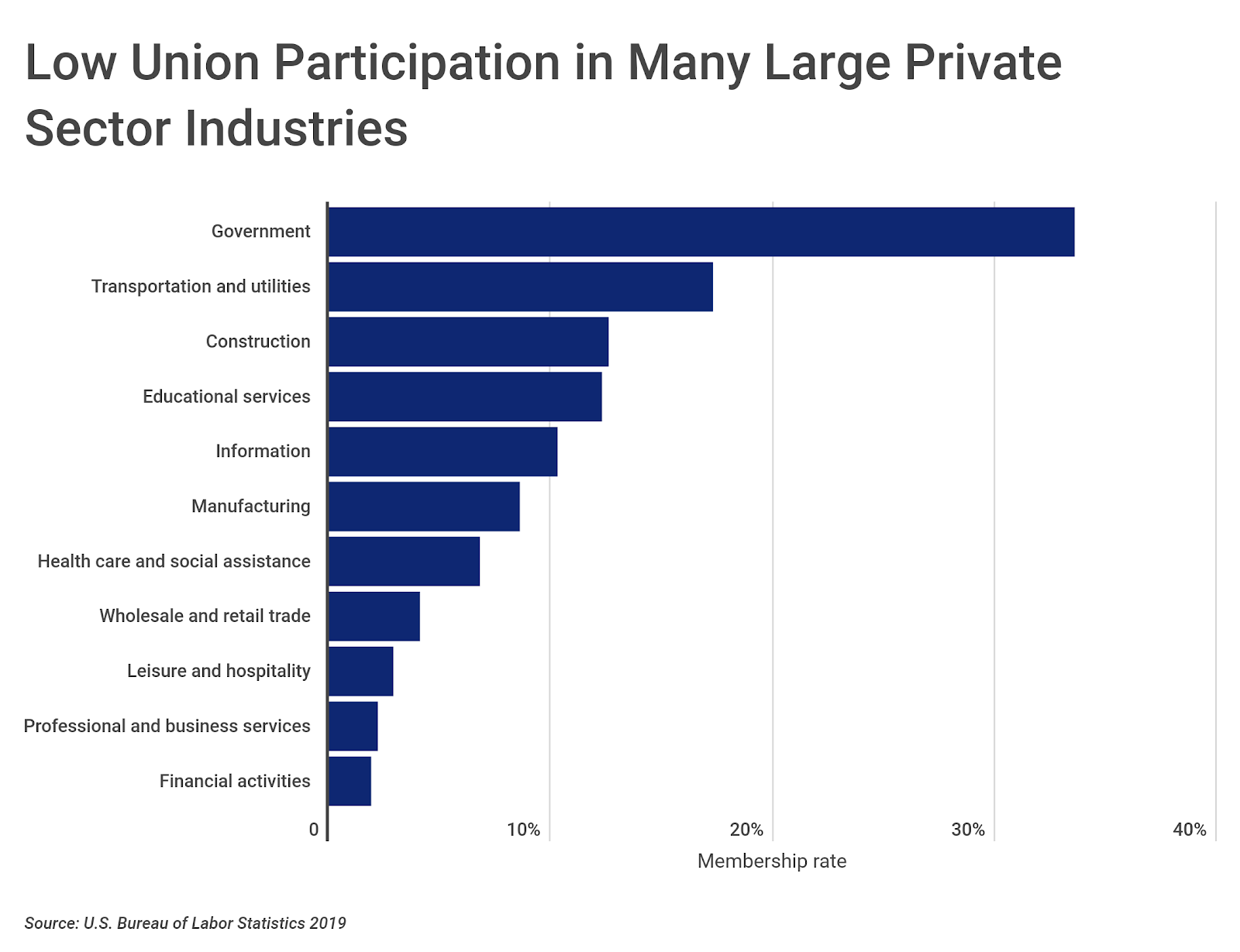
Industry sectors with the highest union membership rates include government, transportation, utilities, and construction. In each of these sectors, union membership rates are above the national average of 10.3 percent. By contrast, employees who work in finance, professional services, leisure, and wholesale/retail trade are far less likely to belong to a union. Union membership in each of these industries is below 5 percent.
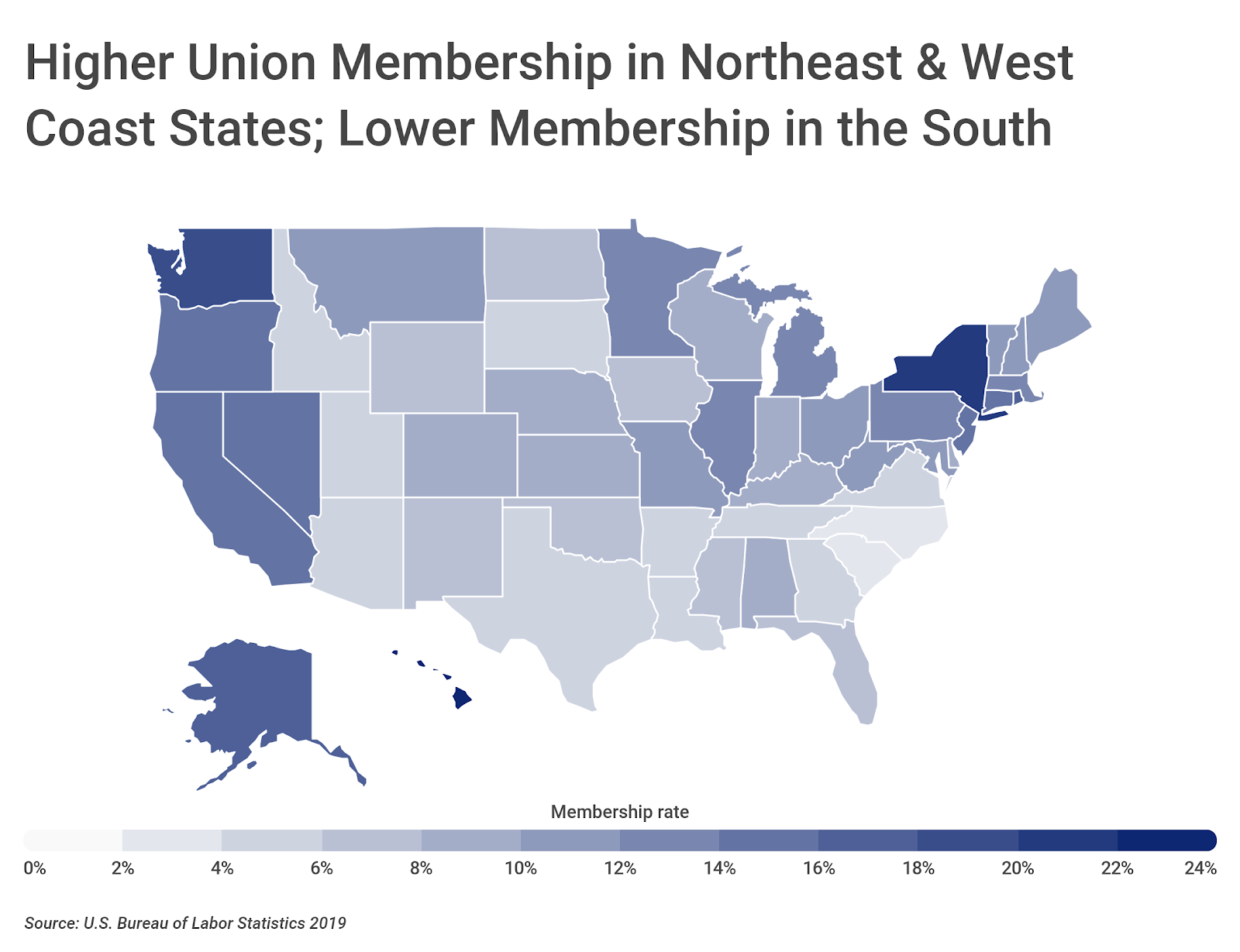
Differences in local economies, politics, and legislation also impact union membership rates. Coastal states such as Hawaii, New York, and Washington have the highest membership rates, at 23.4 percent, 21 percent, and 18.8 percent, respectively. Conversely, more conservative Southern states, such as North Carolina, South Carolina, Virginia, Texas, and Georgia, have membership rates below 5 percent.
To find the most unionized places in America, researchers at Construction Coverage, a review site for commercial auto and construction insurance, analyzed union membership and coverage data from the U.S. Bureau of Labor Statistics and UnionStats.com. They ranked the metropolitan areas with the highest and lowest union membership rates. In addition to union membership, the researchers also included statistics on union representation, which is the share of workers whose terms of work are collectively negotiated (whether or not they are union members).
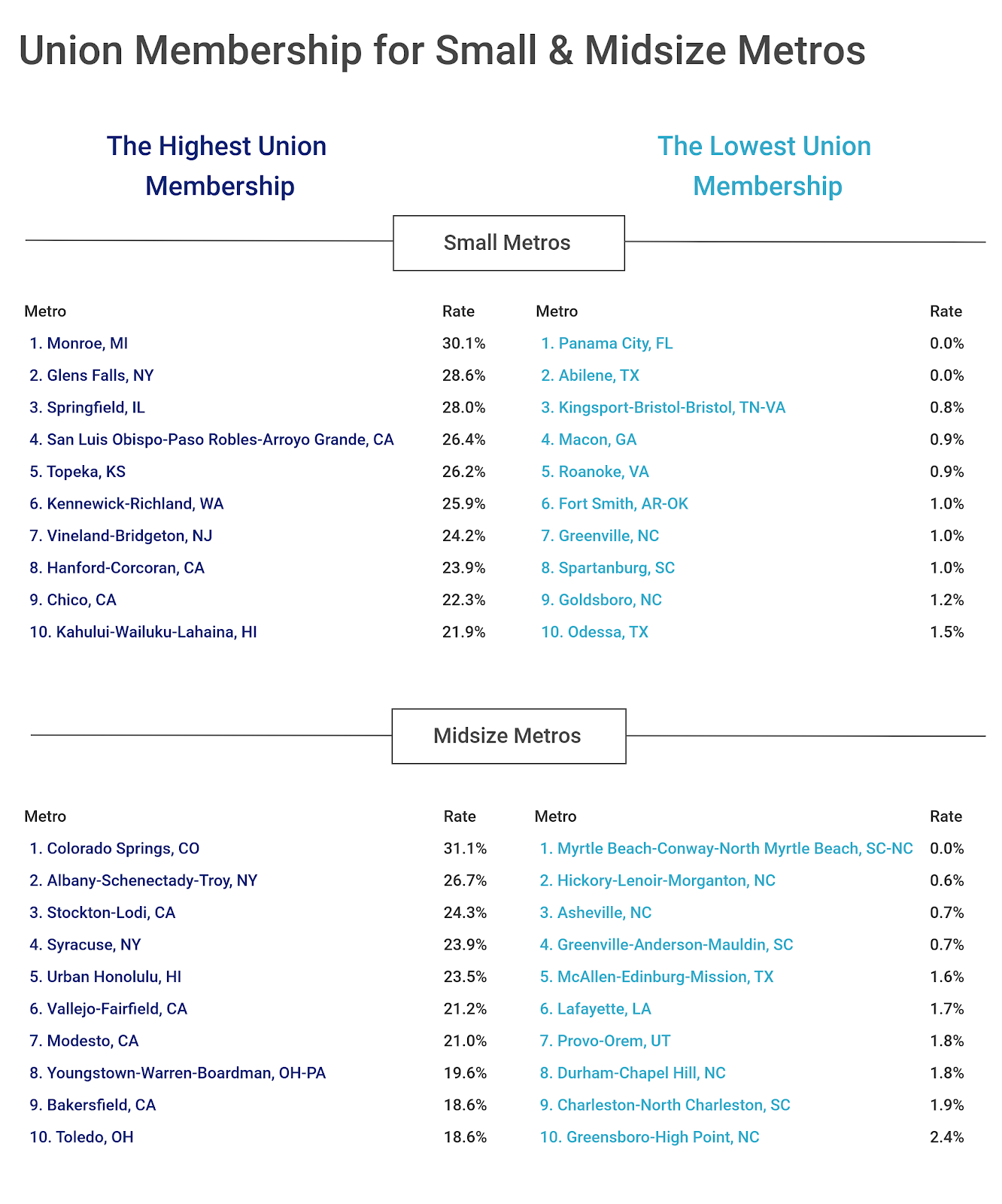
Only metro areas with a population of 100,000 or more were included in the analysis. To improve relevance, metros were grouped into size cohorts based on population size: large metros (1,000,000 residents or more), midsize metros (350,000-999,999 residents), and small metros (less than 350,000 residents). Like the statewide trends, metros on the East and West Coast tend to have the highest union membership, while Southern metros have the least.
Here’s the full list of most and least unionized cities in America.
The Most Unionized Large Metros
Photo Credit: Alamy Stock Photo
1. Riverside-San Bernardino-Ontario, CA
Union membership rate: 22.2%
Union representation rate: 24.2%
Workers who are members of unions: 398,721
Workers who are represented by unions: 434,233
Total employment: 1,792,823
Photo Credit: Alamy Stock Photo
2. New York-Newark-Jersey City, NY-NJ-PA
Union membership rate: 19.1%
Union representation rate: 20.8%
Workers who are members of unions: 1,693,495
Workers who are represented by unions: 1,839,468
Total employment: 8,847,590
Photo Credit: Alamy Stock Photo
3. Seattle-Tacoma-Bellevue, WA
Union membership rate: 18.9%
Union representation rate: 20.2%
Workers who are members of unions: 381,489
Workers who are represented by unions: 407,159
Total employment: 2,017,109
Photo Credit: Alamy Stock Photo
4. Sacramento–Roseville–Arden-Arcade, CA
Union membership rate: 17.6%
Union representation rate: 20.2%
Workers who are members of unions: 182,528
Workers who are represented by unions: 209,151
Total employment: 1,035,905
Photo Credit: Alamy Stock Photo
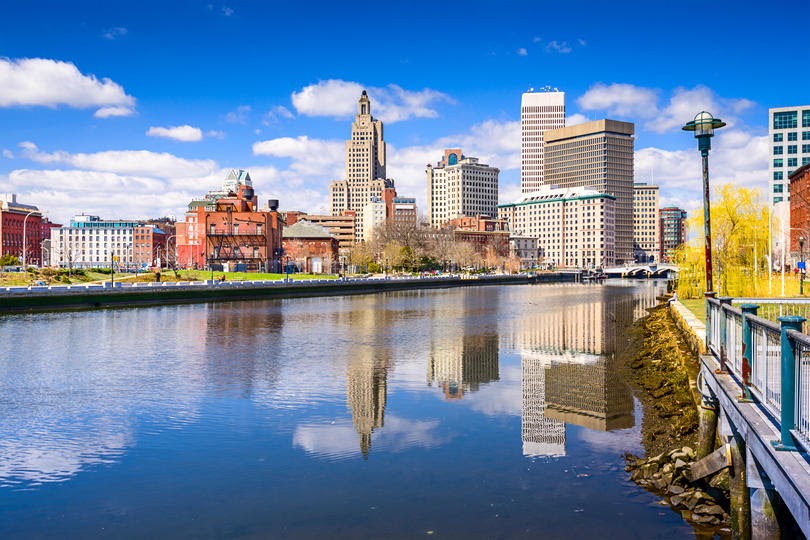
5. Providence-Warwick, RI-MA
Union membership rate: 16.7%
Union representation rate: 18.5%
Workers who are members of unions: 122,526
Workers who are represented by unions: 135,688
Total employment: 734,125
Photo Credit: Alamy Stock Photo
6. Las Vegas-Henderson-Paradise, NV
Union membership rate: 15.4%
Union representation rate: 17.1%
Workers who are members of unions: 153,730
Workers who are represented by unions: 170,667
Total employment: 998,129
Photo Credit: Alamy Stock Photo
7. St. Louis, MO-IL
Union membership rate: 14.8%
Union representation rate: 15.8%
Workers who are members of unions: 192,430
Workers who are represented by unions: 206,058
Total employment: 1,302,999
Photo Credit: Alamy Stock Photo
8. San Francisco-Oakland-Hayward, CA
Union membership rate: 14.5%
Union representation rate: 15.0%
Workers who are members of unions: 323,824
Workers who are represented by unions: 334,763
Total employment: 2,227,936
Photo Credit: Alamy Stock Photo
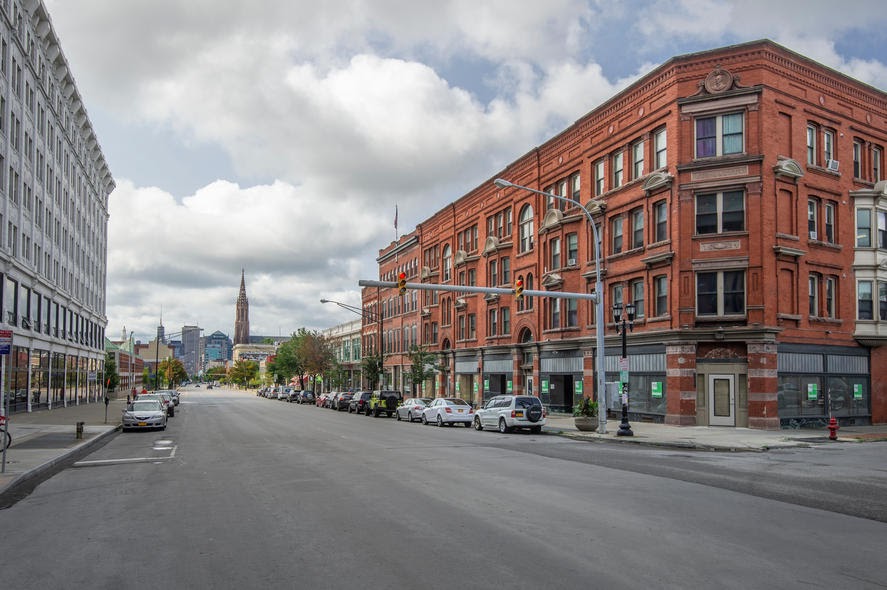
9. Buffalo-Cheektowaga-Niagara Falls, NY
Union membership rate: 14.4%
Union representation rate: 16.3%
Workers who are members of unions: 70,638
Workers who are represented by unions: 79,812
Total employment: 489,287
Photo Credit: Alamy Stock Photo
10. Minneapolis-St. Paul-Bloomington, MN-WI
Union membership rate: 14.1%
Union representation rate: 14.6%
Workers who are members of unions: 249,827
Workers who are represented by unions: 258,417
Total employment: 1,771,101
The Least Unionized Large Metros
Photo Credit: Alamy Stock Photo
1. Austin-Round Rock, TX
Union membership rate: 2.3%
Union representation rate: 2.6%
Workers who are members of unions: 22,526
Workers who are represented by unions: 25,133
Total employment: 980,579
Photo Credit: Alamy Stock Photo
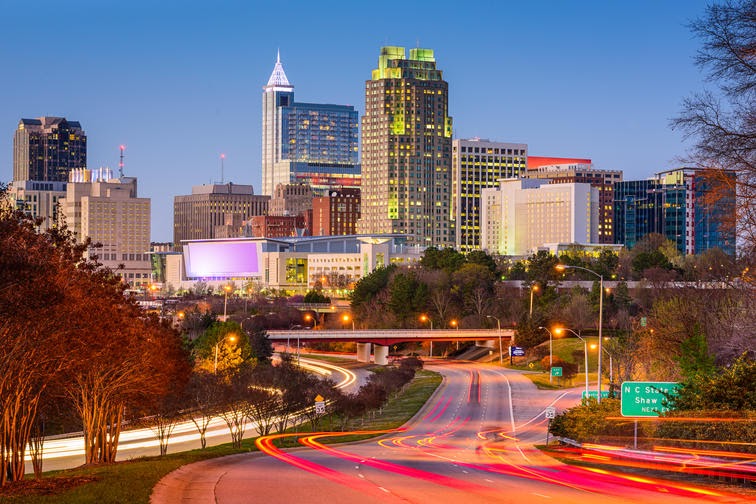
2. Raleigh, NC
Union membership rate: 2.4%
Union representation rate: 3.8%
Workers who are members of unions: 17,115
Workers who are represented by unions: 27,574
Total employment: 721,802
Photo Credit: Alamy Stock Photo
3. Charlotte-Concord-Gastonia, NC-SC
Union membership rate: 2.4%
Union representation rate: 3.2%
Workers who are members of unions: 29,149
Workers who are represented by unions: 38,638
Total employment: 1,218,180
Photo Credit: Alamy Stock Photo
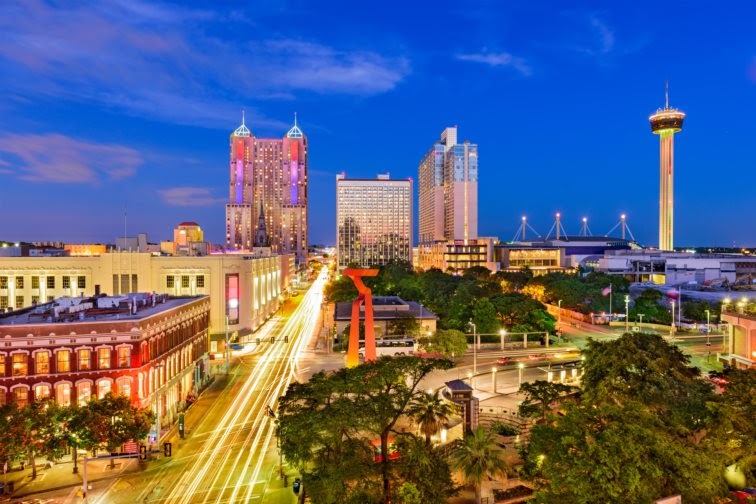
4. San Antonio-New Braunfels, TX
Union membership rate: 3.4%
Union representation rate: 4.0%
Workers who are members of unions: 40,268
Workers who are represented by unions: 47,372
Total employment: 1,175,497
Photo Credit: Alamy Stock Photo
5. Houston-The Woodlands-Sugar Land, TX
Union membership rate: 3.7%
Union representation rate: 4.3%
Workers who are members of unions: 110,390
Workers who are represented by unions: 127,052
Total employment: 2,950,449
Photo Credit: Alamy Stock Photo
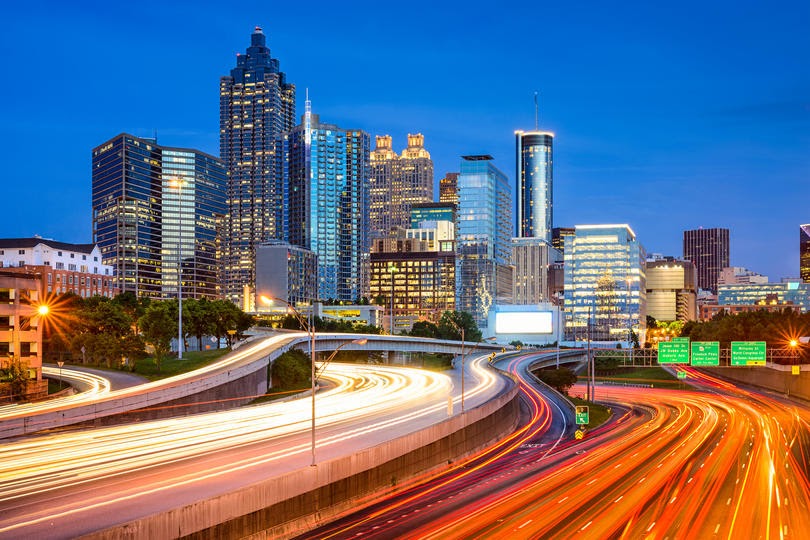
6. Atlanta-Sandy Springs-Roswell, GA
Union membership rate: 4.1%
Union representation rate: 5.1%
Workers who are members of unions: 114,555
Workers who are represented by unions: 139,506
Total employment: 2,761,236
Photo Credit: Alamy Stock Photo
7. Richmond, VA
Union membership rate: 4.2%
Union representation rate: 5.1%
Workers who are members of unions: 24,338
Workers who are represented by unions: 29,398
Total employment: 578,295
Photo Credit: Alamy Stock Photo
8. Nashville-Davidson–Murfreesboro–Franklin, TN
Union membership rate: 4.6%
Union representation rate: 5.6%
Workers who are members of unions: 43,569
Workers who are represented by unions: 52,741
Total employment: 944,354
Photo Credit: Alamy Stock Photo
9. Dallas-Fort Worth-Arlington, TX
Union membership rate: 4.9%
Union representation rate: 6.6%
Workers who are members of unions: 183,799
Workers who are represented by unions: 250,742
Total employment: 3,786,232
Photo Credit: Alamy Stock Photo
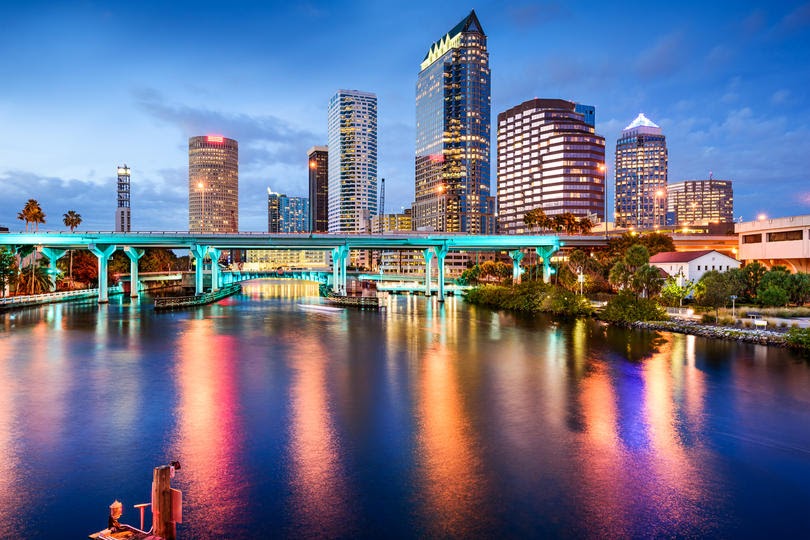
10. Tampa-St. Petersburg-Clearwater, FL
Union membership rate: 5.1%
Union representation rate: 6.3%
Workers who are members of unions: 68,502
Workers who are represented by unions: 84,781
Total employment: 1,352,880
Methodology & Detailed Findings
Data on union membership and coverage is from UnionStats.com. Metropolitan areas were ordered by union membership rate. In the event of a tie, the location with more total union members was ranked higher.
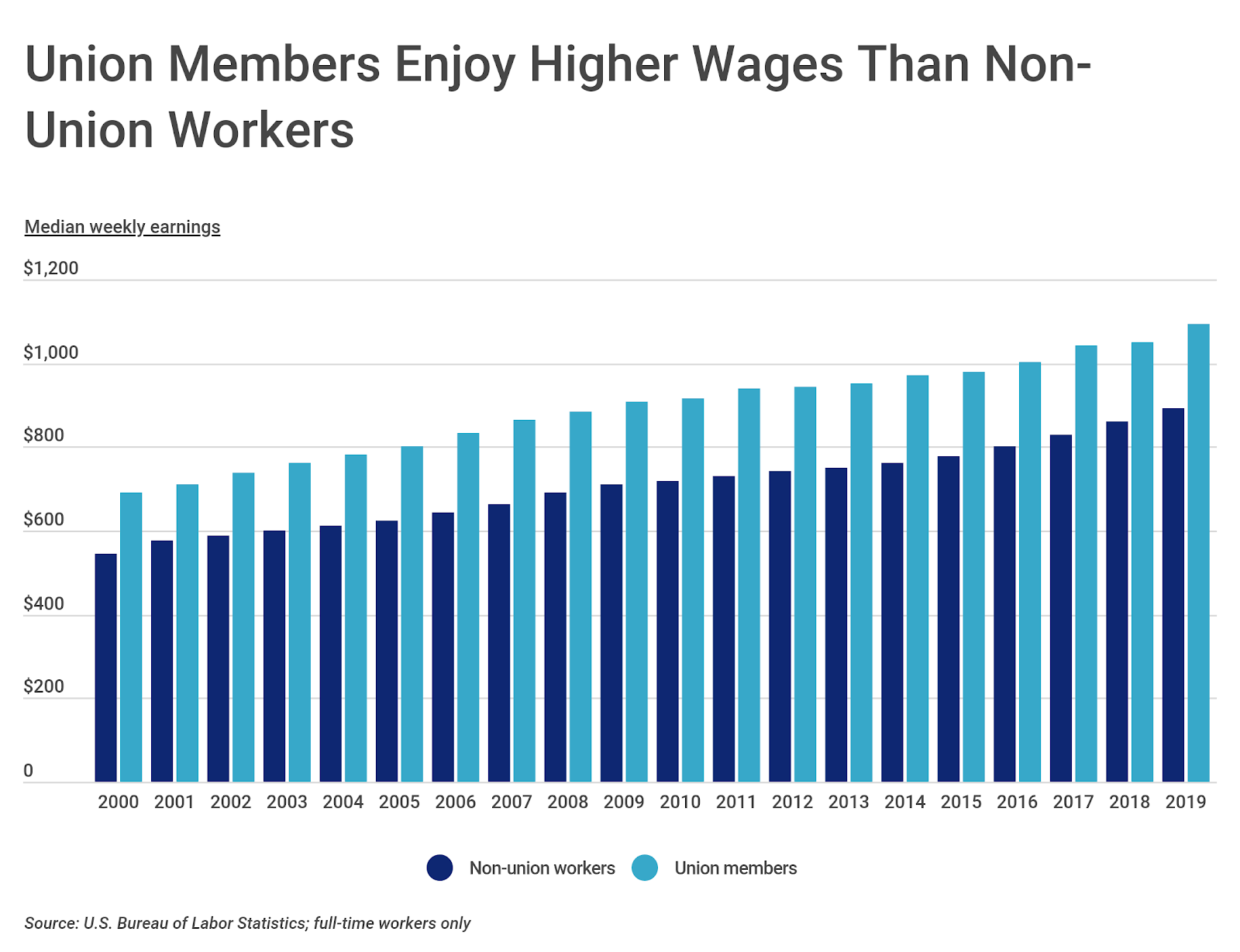
Union workers not only have more protection from unemployment, they also enjoy wage premiums over non-union workers. Data from the Bureau of Labor Statistics found that in 2019, the median wage for full-time union workers was $1,095 per week compared to $892 per week for full-time non-union workers. A major reason for this is union workers’ ability to benefit from the union’s collective bargaining power, rather than relying on individual negotiations with an employer.
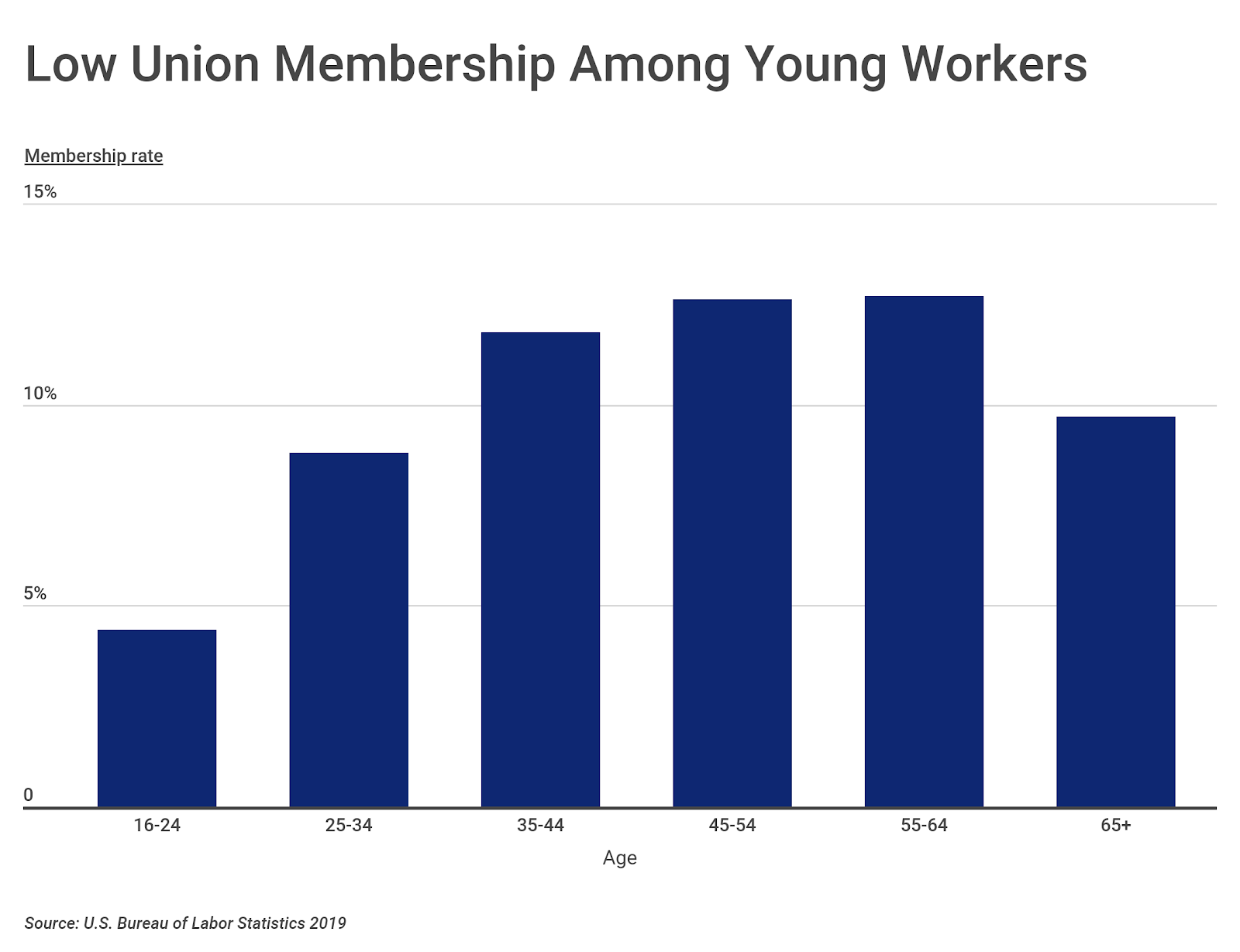
Union membership tends to be lowest for the youngest workers. Workers aged 16-24 and 25-34 have membership rates below 10 percent, compared to 11.8 percent for workers aged 35-44 and 12.6 percent for workers ages 45-54. Declining union membership among young workers could be an indication of even lower rates overall in the future.
In times of crisis, workers not represented by unions may face worse consequences than workers represented by unions, and locations with lower union membership rates might also be less resilient to economic hardship. Looking toward a post-COVID-19 future, the need for emergency protections for vulnerable workers will remain a hot-button issue as the nation starts its path toward healing.

 Photo Credit: Alamy Stock Photo