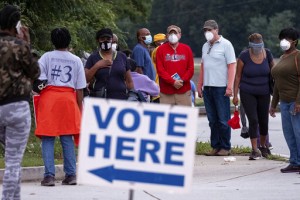
A disturbing number of courts are refusing to protect the right to vote. Although some federal district courts have eased certain election laws to make it easier to vote during the pandemic, the Supreme Court and federal appellate courts have mostly reversed these rulings. The appellate courts are instead unduly deferring to state legislatures and election officials.
Sometimes, that deference can protect voting rights, such as when courts have rejected Trump campaign challenges to state rules that ease voter access. But more perniciously, some courts have essentially blamed voters for their difficulties in voting during the pandemic when states have failed to make it easier to vote. States are given a free pass to maintain restrictive voting rules. This is the sorry state of voting rights in 2020 America.
A common thread runs through these judicial opinions: State legislatures and election officials should have the final say on election administration.
But that reasoning severely devalues the constitutional right to vote. There should be less, not more, deference to state laws when those laws make it harder to participate in our democracy, especially during a pandemic.
We have seen this undue deference to state laws from the US Supreme Court, which rejected a lower court ruling that removed the witness requirement for absentee ballots in South Carolina. Justice Brett Kavanaugh wrote that a “State legislature’s decision either to keep or to make changes to election rules to address Covid-19 ordinarily should not be subject to second guessing by an unelected federal judiciary, which lacks the background, competence, and expertise to assess public health and is not accountable to the people.”
But the very point of the courts in constitutional cases is to provide a check on legislatures, which might craft voting rules (or, in this instance, refuse to act) in an effort to shape the electorate and keep themselves in power.
The Fifth Circuit Court of Appeals, in rejecting a lower court decision to let Texas counties have multiple ballot drop box locations, rested its analysis on the notion that the court should not disrupt the governor’s limitation of drop boxes to one spot per county. The court had the gall to suggest that Texas’s rules actually amount to an “expansion” of the right to vote because voters have more days than before to hand deliver a ballot to the county clerk’s office. That analysis glosses over the harm in having only one drop off location in a large county and fails to acknowledge that counties in Texas are not the same size. The decision could lead to even longer lines in places like Harris County (Houston), which has over 2 million registered voters.
Or take the decision out of Indiana from the Seventh Circuit Court of Appeals, which upheld the state’s refusal to expand vote by mail to voters under 65 who do not have an excuse other than concerns over Covid-19. Because the case involved the ability to vote via absentee ballot, the court said that the issue was not about the “right to vote” but instead the “privilege” to vote in a particular way.
That’s nonsense. The right to vote is the same regardless of how someone exercises that right. But perhaps more gallingly, the court completely absolved the state legislature from any responsibility in making it harder to vote, stating, “It’s the pandemic, not the State, that might affect Plaintiffs’ determination to cast a ballot.” The same court also reversed a district court decision that had extended Indiana’s deadline for accepting absentee ballots.
What happened to the constitutional protection to the right to vote? Why are the voters at fault?
A different panel of the same court made a similar error in a case from Wisconsin, reversing a lower court decision that had made several changes such as extending the deadline for absentee ballots to arrive. The court suggested that “[D]eciding how best to cope with difficulties caused by disease is principally a task for the elected branches of government.” But what about when those elected branches fail to act, causing an infringement of the constitutional right to vote? Courts should not be powerless.
That very concept — that the whole reason for courts’ existence is to protect constitutional rights when the elected branches won’t — prompted a scathing dissent from Judge Ilana Rovner, an appointee of Republican President George H.W. Bush. Her entire dissent is worth a read, but here’s a key point: “When a state proves unwilling or unable to confront and adapt to external forces that pose a real impediment to voting, it places into jeopardy the most cherished right that its citizens enjoy.” Judge Rovner concluded her dissent with a chilling statement: “Good luck and G-d bless, Wisconsin. You are going to need it.”
The examples abound. A Georgia district court perhaps best identified the problem when rejecting a challenge to Georgia’s new implementation of ballot marking device (BMD) voting machines based on their unreliability: The judge sounded like she was almost apologizing for ruling against the plaintiffs given the likely infringement on the right to vote, but ruled in favor of the state because of Supreme Court and Eleventh Circuit precedent that required her to defer to state election officials, especially as the election draws near.
Why even have courts if they will simply rubber stamp state laws that harm voting rights? To add to the problem, this deference to state legislatures is in addition to the general under-protection of the right to vote.
It doesn’t have to be this way. Some states have expanded the right to vote, even in Republican-controlled places like Utah and Kentucky. State courts, such as the Pennsylvania Supreme Court and the Nevada Supreme Court, have issued pro-democracy rulings. And there’s a growing movement for a new constitutional amendment to recognize explicitly the right to vote.
There’s a path forward to broader voting rights protections. But it depends on a fidelity to the foundational concept of our democratic republic: that everyone should be allowed to vote without hindrance and that courts should not just blindly defer to states’ unduly restrictive voting rules.