Although records come and go, some of the world’s records that have been claimed by Nebraska have included “the packing center of the world,” the largest horse and mule market, the largest creamery, the largest macaroni plant and the largest butter market.
As far as records for the U.S. go, a few of the improbable ones include Nebraska’s having the most school districts of any state and the most miles of shoreline, while Lincoln once claimed to have more acres of parks per capita than any other American city. Among the unlikely but true list was the claim that Nebraska was the home of the largest manmade forest in the world.
Rev. C. S. Harrison established the village of Arborville in York County in 1874. Harrison claimed that, aided by tree planting, Nebraska, and the entire area west to the Rocky Mountains would soon be forested.
In 1884 Charles Edwin Bessey came to the University of Nebraska as a professor of botany and dean of the Industrial College. Bessey, who had come from a well-forested state, noted that Nebraska seemed to have “no native tree growth.”
At the same time, Bessey noticed that kinnikinic was growing in the Sandhills and remarked that its presence indicated yellow pine would also grow. To that end, he approached the U.S. Department of Agriculture’s Division of Forestry seeking permission and help in experimenting with timber culture in western Nebraska. The response was that they would supply seedlings if Bessey could supply appropriate land.
Another university professor and his brothers owned a ranch in Holt County near Swan Lake which they offered for the project. About 13,500 yellow pine seedlings were then planted on the Bruning (sometimes Bruner) brothers ranch, though the project drew complaints from ranchers who wanted land to be left open for cattle grazing. As the university occupied an ever-increasing amount of Bessey’s time, the project was set aside and virtually forgotten.
In May of 1892, the village of Halsey was established around a post office in Thomas County on land owned by Rebecca Rush, who had settled there in 1887. The village was named for Halsey Yates of Lincoln, a land surveyor for the Burlington & Missouri River Railroad who was instrumental in establishing the siding and depot on the site. The village reached its peak population of 160 in 1950 but the railroad’s station was discontinued in 1957.
Through the original efforts of J. Sterling Morton, Arbor Day, originally dubbed Sylvan Day, was established on April 22, 1872, Morton’s birthday. In 1895 the Nebraska Legislature declared “that Nebraska shall hereafter … be known as the Tree Planter’s State,” resulting in an ever-increasing interest in trees in the state and the entire country.
Also, in the late 1890s, the federal government, through the Bureau of Forestry, agreed to set aside reserves and in 1901 sent a reconnaissance party to visit the Swan Lake experiment. Though even Bessey feared the largely ignored and forgotten project had failed, they discovered the trees had not only survived but thrived to 18 to 20 feet in height. This led to President Theodore Roosevelt’s 1902 creation of two Nebraska reserves — the Dismal River, later known as the 93,000 acre Bessey Section and the 115,000 acre Niobrara Reserve. The following year “70,000 jack pine and 30,000 western yellow pine seedlings were planted.” A third reserve was set aside in 1906 and in 1907 the three reserves were collectively known as the Nebraska National Forest.
In 1910 a fire, which started west of the forest, burned several hundred acres of trees. Five years later the Dismal River and Halsey Nursery were renamed the Bessey Division and Nursery.
The 1930s saw a drought severely affect the forest but also brought two Civilian Conservation Corps camps and a 60-man Veterans Construction Corps contingent which built roads, a shelter house, swimming pool and picnic grounds as well as two 45,000-gallon reservoirs and two miles of deer-proof fencing.
In 1939 a WPA publication advertised that the Halsey Division of the Nebraska National Forest was open to the public “admission free [though] cars must be equipped with mufflers and cut-offs must be kept closed on hay roads.”
By the 1950s the Bessey Nursery was supplying seedlings to Colorado, Wyoming, Montana and South Dakota in addition to Nebraska while plantings had reached 200 billion of about a dozen varieties of trees.
In 1960 the Pine Ridge District and the Oglala Grasslands were added to the Nebraska National Forest, which then totaled 325,000 acres. A lightning strike in 1965 destroyed 16,000 acres of some of the oldest portion of the forest, consisting of an estimated 2.5 million trees.
Today the Nebraska National Forest is joined by the McKelvie National Forest in Cherry County. The Bessey Nursery has been placed on the National Register of Historic Places and though the Nebraska National Forest was replaced by a forest in Chica as the world’s largest, it retains the title of the “largest human made forest in the United States.” In addition to the forest’s claim, Omaha’s Henry Doorly Zoo lays claim to the world’s largest geodesic dome and Nebraska still holds title to the largest kolache.
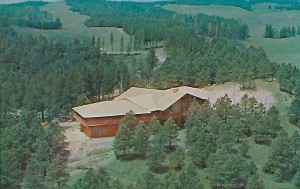
This is the main lodge at the 90,000-acre Nebraska National Forest, overlooking the Middle Loup River. The camp was built by 4-H Club members and friends.