Lane said that tattoos have a history that is cross cultural that has existed for thousands of years. The world of tattooing is socially constructed and the artists learn to become members of it.
“Tattooing and tattoo work is far more complex than most of us see,” Lane said. “Most of us don’t spend our days in tattoo shops and around them in general, so we don’t see the amount of labor that goes into making tattooing happen.”
Lane went on to say that the tattoo industry is filled with behind the scenes work, such as those who build the machines or build the network to sell the equipment. There is a multitude of pieces that work together to create tattoos and keep the industry alive.
“There’s a lot that goes into this, moreover, tattoo artists in the current age work very hard to be good at what they do,” Lane said. “While they have people to look up to, tattooing does not necessarily have a rating system like we have in the institutional world. They’re figuring out this world on their own where there aren’t these markers that are easy to compare themselves to others.”
Initially, Lane wanted to conduct research on political violence, but he had mentors that persuaded him to use his knowledge of the tattoo industry as the basis for his research and his book. Lane decided that instead of studying what people’s tattoos mean, he would focus on the tattoo shop itself and the process of how we create tattoos.
Lane became interested in tattooing before the “tattoo boom” in the early 2000s when he was spending a great amount of time in his friends’ older brother’s tattoo shop.
“It was a lot harder to get into tattooing then. We didn’t have television shows putting it in people’s living rooms every week, and there wasn’t this widespread internet accessibility,” Lane said. “I think to some degree, to get involved in tattooing you had to go find somebody. Now, it’s much more accessible, but for me personally, I miss to some degree that intimacy of the small community around a tattoo shop.”
Lane spent several months interviewing tattoo artists about how they survive, and then his research expanded as he gathered information about how they engaged in collective activity.
“When we think of something like tattooing in our heads, we tend to credit the tattooer as the sole person responsible for making it. But like any cultural good, there are many people involved in the production of it,” Lane said. “They’re reliant on many other people, and there’s a lot of cumulative knowledge that is passed on. While one person gets credit for that piece of art, it really is a collective world that makes it happen.”
“The Other End of the Needle” concentrates on how tattooing has survived as an occupation in capitalism. While many jobs have professional associations and unions to protect workers, tattoo artists typically do not have this. Lane said that many jobs without this type of protection disappear or become low wage sector positions that are rationalized and bureaucratic.
“Tattooers have been a bit resilient as the forces of capitalism have bore down upon them. As we’ve seen many jobs go the way of certification and formal credentials and so forth, tattooers don’t rely on that,” Lane said. “They have a bit more humanist understanding of the world. Even to create a tattoo on some person….it requires intimate face to face interaction….things we have seen disappear from other spheres.”
The entire industry is complex, and Lane said that even with as much work as he has done, he continues to find new information about different groups and tattooing.
Historically, Lane said the top reasons to be tattooed weren’t for deviant reasons but were positive characteristics of society. Largely, tattoos were a memorial, familiar or an occupation-based symbol.
In todays world where consumerism is high and culture contains many of the same elements from city to city, such as the same chain-based stores and restaurants, tattooing grants individuals a way to consume culture in a unique way.
“I think it should be no surprise that tattooing is as popular as it is right now. It gives us the way to cultivate distinct identities in a time period where some of the larger forms of production and consumption seem the same across location,” Lane said. “Obviously, there’s a caveat to this as we produce more culture now than we ever have because we’re far more efficient at it and there’s more accessibility with the internet. I think there’s a reason why we have these tattooed bodies now and we see quite a few more of them.”
Currently, Lane teaches Crime and Behavior, Social Construction of Crime and Criminological theory courses. “The Other End of the Needle” can be purchased at rutgersuniversitypress.org.
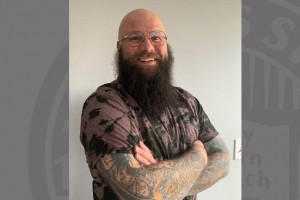
Criminal Justice Sciences professor David Lane recently published his book “The Other End of the Needle: Continuity and Change among Tattoo Works,” all about the intricacy of tattooing.