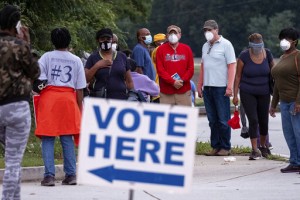
No matter how the election ends, it is clear that American voters did not resoundingly repudiate President Donald Trump. That comes as a disappointment to those of us who have found much about his presidency dangerous and inexcusable, but it also demands a closer look at what produced this outcome.
The election confirmed how profoundly divided the country is — and will be, whether our president is Trump or Joe Biden.
We already know how Trump will govern if he wins. If Biden wins, his pledge to bring Americans back together will prove just as monumental as the other problems he will face, including the pandemic and the shattered economy.
“We are campaigning as Democrats,” Biden said Wednesday in remarks in Delaware, “but I will govern as an American president. The presidency, itself, is not a partisan institution. It’s the one office in this nation that represents everyone and it demands a duty of care for all Americans and that is precisely what I will do.”
In a healthy, well-functioning political system, the country should be able to come together to solve these problems. But it’s not clear at this fractious moment whether such unity is likely or even possible.
To bring Americans together and respond to the people’s needs, Biden will need to face the stark reality that nearly half of the voters supported Trump, even in the midst of the worst public health crisis in a century and the worst economic conditions since the Great Depression.
Why? Some of it may be because of poor tactical decisions by the Biden team. Much of it is because of Trump’s willingness to lie shamelessly, to the point that many bought into his countless lies, always with the unflagging support of the complicit Republicans and the right-wing media machine. But that doesn’t tell the whole story.
Biden seems to have made a mistake by focusing so much of his campaign on the pandemic. It made sense to do that, but he should have also worked hard to counter Trump’s phony claim that he had built the best economy in the country’s history until the coronavirus struck. Exit polls, if we can believe them, show the economy was the voters’ top concern, with the pandemic ranking a distant third.
Trump’s persistence in downplaying the virus apparently persuaded many voters.
Indeed, Biden may well trimmed his prospects by taking the ethical path of campaigning safely, limiting his interaction with voters, in contrast to Trump’s super spreader events. He deserves praise for that.
Trump also benefited from his false claims that Biden is a socialist, which gave him a huge boost with many voters, pivotally in Florida, where many have roots in countries devastated by socialist regimes.
Trump also exploited racism and xenophobia, one of the ugliest aspects of his presidency and his campaign.
But the millions who voted for Trump were not all gullible or racist. Yes, Trump undoubtedly won the racist vote, the homophobic vote, the xenophobic vote. But tens of millions of Americans have seen and heard something else from Trump that appeals to them. We should make an effort to understand what that is.
Trump has charisma. He portrays himself as a tough defender of America and, in particular, of blue collar and rural Americans. The issues on which he promises to fight for the people are worth noting. Ignore for a moment what he has done, and listen to what he has promised, what he said that resonated with voters — except for the racist parts.
In 2016, Trump tapped into a sense of anguish in areas of the economy that were shrinking. He promised to go after America’s trade partners who, he claimed, were taking advantage of the United States. This caught voters’ attention because there are big sectors of the US economy that have been bulldozed by the global economy.
Manufacturing has been all but uprooted and replanted in China; coal has been crushed by valid environmental concerns, and job security for millions of workers has been vanishing as the gig economy ascends — offering meager compensation, instead of solid jobs with benefits and job security. We’ve all met Uber drivers struggling to make ends meet after losing a good job.
At the same time — and evident in the election results — the divide between urban and rural America has been growing starker. Rural, more conservative voters are deeply uncomfortable with some of the social and cultural changes in the country.
Democrats would do well to delve into these issues and try to learn from the concerns of Trump voters. Anguish and fear of economic dislocation predated the pandemic. This has to do with long-term changes in the economy, not this temporary crisis.
And fear of what the crowds in the cities stand for predates Trump’s ugly, dog-whistle claims that Democrats would destroy the suburbs.
The country desperately needs to come together for common objectives. That requires respecting each other’s views, making an effort to understand, explain, and try to bridge the gap, and finding ways to address the legitimate concerns of people with whom you disagree.
Certain items are not negotiable, obviously. Racism and prejudice are intolerable. But I don’t think those are the principal motivations behind most of the support for Trump.
Many Americans want a strong president, one who will take up the fight for them at home and abroad. Whether or not Trump has done that is immaterial at this stage. The country is in dire straits. If Americans can work together, they will find solutions much faster. Staying at war with each other will only prolong the struggle.