Underwater and on fire: US climate change magnifies extremes
By SETH BORENSTEIN - AP Science Writer
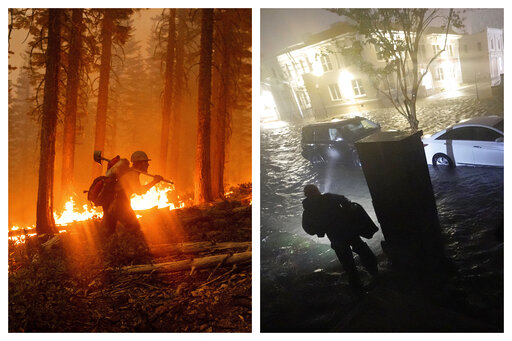
This combination of photos shows a firefighter at the North Complex Fire in Plumas National Forest, Calif., on Monday, Sept. 14, 2020, left, and a person using a flashlight on flooded streets in search of their vehicle, Wednesday, Sept. 16, 2020, in Pensacola, Fla. In the past week, swaths of the country have been burning and flooding in devastating extreme weather disasters. (AP Photo/Noah Berger, Gerald Herbert)
America’s worsening climate change problem is as polarized as its politics. Some parts of the country have been burning this month while others were underwater in devastating extreme weather disasters.
The already parched West is getting drier and suffering deadly wildfires because of it, while the much wetter East keeps getting drenched in mega-rainfall events, some hurricane related and others not. Climate change is magnifying both extremes, but it may not be the only factor, several scientists told The Associated Press.
“The story in the West is really going to be … these hot dry summers getting worse and the fire compounded by decreasing precipitation,’’ said Columbia University climate scientist Richard Seager. “But in the eastern part more of the climate change impact story is going to be more intense precipitation. We see it in Sally.”
North Carolina State climatologist Kathie Dello, a former deputy state climatologist in Oregon, this week was talking with friends abut the massive Oregon fires while she was huddled under a tent, dodging 4 inches (10 centimeters) of rain falling on the North Carolina mountains.
“The things I worry about are completely different now,” Dello said. “We know the West has had fires and droughts. It’s hot and dry. We know the East has had hurricanes and it’s typically more wet. But we’re amping up both of those.”
In the federal government’s 2017 National Climate Assessment, scientists wrote a special chapter warning of surprises due to global warming from burning of coal, oil and natural gas. And one of the first ones mentioned was “compound extreme events.”
“We certainly are getting extremes at the same time with climate change,” said University of Illinois climate scientist Donald Wuebbles, one of the main authors.
Since 1980, the National Oceanic and Atmospheric Administration has tracked billion-dollar disasters, adjusting for inflation, with four happening in August including the western wildfires. NOAA applied meteorologist Adam Smith said that this year, with at least 14 already, has a high likelihood of being a record.
Fifteen of the 22 billion-dollar droughts in the past 30 years hit states west of the Rockies, while 23 of the 28 billion-dollar non-hurricane flooding events were to the east.
For more than a century scientists have looked at a divide — at the 100th meridian — that splits the country with dry and brown conditions to the west and wet and green ones to the east.
Seager found that the wet-dry line has moved about 140 miles (225 kilometers) east — from western Kansas to eastern Kansas — since 1980.
And it’s getting more extreme.
Nearly three-quarters of the West is now in drought, according to the U.S. Drought Monitor. Scientists say the West is in about the 20th year of what they call a “megadrought,” the only one since Europeans came to North America.
Meager summer rains are down 26% in the last 30 years west of the Rockies. California’s anemic summer rain has dropped 41% in the past 30 years. In the past three years, California hasn’t received more than a third of an inch (0.8 centimeters) of rain in June, July and August, according to NOAA records.
California also is suffering its worst fire year on record, with more than 5,300 square miles (13,760 square kilometers) burned. That’s more than double the area of the previous record set in 2018. People have been fleeing unprecedented and deadly fires in Oregon and Washington with Colorado also burning this month.
“Climate change is a major factor behind the increase in western U.S. wildfires,” said A. Park Williams, a Columbia University scientist who studies fires and climate.
“Since the early 1970s, California’s annual wildfire extent increased fivefold, punctuated by extremely large and destructive wildfires in 2017 and 2018,” a 2019 study headed by Williams said, attributing it mostly to “drying of fuels promoted by human‐induced warming.”
During the western wildfires, more than a foot rain fell on Alabama and Florida as Hurricane Sally parked on the Gulf Coast, dropping as much as 30 inches (76 centimeters) of rain at Orange Beach, Alabama. Studies say hurricanes are slowing down, allowing them to deposit more rain.
The week before Sally hit, a non-tropical storm dumped half a foot of rain on a Washington, D.C., suburb in just a few hours. Bigger downpours are becoming more common in the East, where the summer has gotten 16% wetter in the last 30 years.
In August 2016, a non-tropical storm dumped 31 inches (nearly 79 centimeters) of rain in parts of Louisiana, killing dozens of people and causing nearly $11 billion in damage. Louisiana and Texas had up to 20 inches (51 centimeters) of rain in March of 2016. In June 2016, torrential rain caused a $1 billion in flood damage in West Virginia.
In the 1950s, areas east of the Rockies averaged 87 downpours of five inches or more a year. In the 2010s, that had soared to 149 a year, according to data from NOAA research meteorologist Ken Kunkel.
It’s simple physics. With each degree Celsius (1.8 degrees Fahrenheit) that the air warms, it holds 7% more moisture that can come down as rain. The East has warmed that much since 1985, according to NOAA.
While climate change is a factor, Seager and Williams said what’s happening is more extreme than climate models predict and there must be other, possibly natural weather phenomenon also at work.
Pennsylvania State University climate scientist Michael Mann said that La Nina — a temporary natural cooling of parts of the equatorial Pacific that changes weather worldwide — is partly responsible for some of the drought and hurricane issues this summer. But that’s on top of climate change, so together they make for “dual disasters playing out in the U.S.,” Mann said.
As for where you can go to escape climate disasters, Dello said, “I don’t know where you can go to outrun climate change anymore.”
“I’m thinking Vermont,” she said, then added Vermont had bad floods from 2011’s Hurricane Irene.
The Associated Press Health and Science Department receives support from the Howard Hughes Medical Institute’s Department of Science Education. The AP is solely responsible for all content.