UN diplomacy goes impersonal, but what’s lost along the way?
By TED ANTHONY - AP National Writer
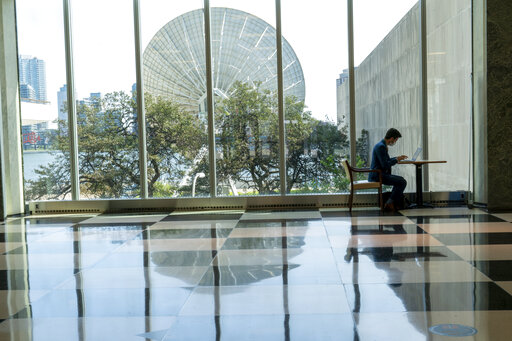
A member of the Irish delegation works on his computer in the main lobby of the United Nations headquarters, Monday, Sept. 21, 2020. In 2020, which marks the 75th anniversary of the United Nations, the annual high-level meeting of world leaders around the U.N. General Assembly will be very different from years past because of the coronavirus pandemic. Leaders will not be traveling to the United Nations in New York for their addresses, which will be prerecorded and most events related to the gathering will be held virtually. (AP Photo/Mary Altaffer)
Each year, for nearly seven decades, the spectacle has unfolded in grand and scripted fashion: Leader after world leader striding to the podium inside the colossal U.N. General Assembly chamber to uncork carefully calibrated speeches, posture publicly and speak the language of statecraft.
And each year, in the hallways of the United Nations and the hotels that surround it, intensive doses of more intimate, more genuine diplomacy take place in quiet conversations, in small bilateral meetings, in one-on-one huddles that gestate subtle understanding and, sometimes, even prevent wars.
This year, the spectacle part is still happening — remotely this time, on video, in prerecorded fashion, far from the madding diplomatic crowd. But because of the coronavirus pandemic, that other, more personal part of U.N. diplomacy is silently, deafeningly absent.
With it disappears something intangible but vital to the art of nations getting along: the in-person human touch. This is a time when it would really help the world to be able to talk to itself. And this week, on the socially distanced grounds of the United Nations, it can’t.
“When you think about the U.N., that’s the essence of it. In order for the game to work, you have to have empathy. You have to treat each other diplomatically. What does that look like when you remove the actual humanity from it?” wonders David Sax, author of “The Revenge of Analog: Real Things and Why They Matter.”
At the General Assembly’s yearly high-level “meeting” of leaders this week, the U.N.’s halls will be mostly empty. On the chamber’s floor, delegations will be limited to one person for each of the U.N.’s 193 member nations. The giant screens will be full — of far-off leaders who took no planes to convene but, instead, recorded messages in the safety and isolation of their home countries and their offices.
“I expect not very much, to be honest,” says Richard Gowan, U.N. director for Crisis Group. “The idea that prime ministers and presidents are going to be sitting at home with a bucket of popcorn watching each other’s televised speeches is a bit silly.”
Pandemic-era diplomatic gatherings might be safer, less expensive, less logistically challenging. They might even be more efficient; we’ll get a glimpse of that by week’s end.
What they are not, however, is intimate and nuanced and filled with serendipitous opportunities for breakthroughs.
“There’s subtlety that’s lost, and you also lose the potential to explore ways of resolving issues,” says Jeff Rathke, who was director of the U.S. State Department press office in 2014-15 and, before that, deputy chief of staff to the NATO secretary-general in Brussels.
“We’re stuck with the mannered set pieces, and we’re deprived of all the lubrication or cushioning that goes on around all those things,” says Rathke, now president of the American Institute for Contemporary German Studies. “It makes the system in some ways more brittle, because you don’t have that cushioning that diplomacy usually provides.”
This week at the United Nations — or, more accurately, NOT at the United Nations — is both a dramatic expression of, and a microcosm of, what many people have been dealing with in the months since COVID-19 began shutting down or restricting great swaths of civilization.
As many retreated into homes, and those fortunate enough to keep their jobs started doing them in the same spaces where they live their personal lives, human contact in the workplace became a thing of the past for the moment. The question was batted around endlessly: Can we effectively get along with, collaborate with, achieve the same results with our colleagues without the subtleties and cues of in-person contact?
Imagine if instead of the COVID-fueled virtual distance causing inefficiency on the job, it provoked armed conflict or scuttled a trade deal. Imagine if a lost conversation by the coffee machine affected the well-being of millions. That’s melodramatic, sure, but it’s sort of what we’re talking about here.
“We will miss that contact, that personal contact that I believe is very important for diplomacy to be effective,” U.N. Secretary-General Antonio Guterres said last week. And Turkish diplomat and politician Volkan Bozkir agreed that talks over coffee, at lunch and in the U.N. corridors are essential “because nothing can replace this kind of communications.”
“It helps people to understand what others think and also gives the possibility to find if there is a possibility for a compromise,” said Bozkir, who took over the one-year presidency of the General Assembly last week.
In the meantime, it’s not as if there are no other methods of communication. Diplomats diplomatted remotely well before coronavirus descended. And when the General Assembly is over, there are cables and encrypted emails and phone calls and Zoom calls and shuttle diplomacy to be had.
There will be no memorable in-real-life moments like Soviet leader Nikita Khrushchev’s fabled shoe-brandishing at the General Assembly in 1960, it’s true. But there will also be no moments like the one George W. Bush had with Vladimir Putin in 2001, in which he “looked the man in the eye” and “was able to get a sense of his soul.” As many would attest, it’s hard to do that even with Zoom, much less prerecorded video.
“In a way, I don’t see what the point of it all is going to be. The speeches will be made for domestic consumption, or to impress allies or possibly enemies, but there won’t be any give and take,” says Margaret MacMillan, a diplomatic historian and author of the new book, “War: How Conflict Shaped Us.”
“Face-to-face meetings don’t always solve everything,” says MacMillan, who teaches international relations at the University of Toronto. “But at least contact will give you some sense of the others that you’re dealing with. And some sense is better than none.”
Ted Anthony, director of digital innovation for The Associated Press, has written about international affairs since 1995. Follow him on Twitter at http://twitter.com/anthonyted