BERLIN (AP) — As Jews around the world gather Sunday night to mark the beginning of Yom Kippur, many in Germany remain uneasy about going together to their houses of worship to pray, a year after a white-supremacist targeted a synagogue in the eastern city of Halle on the holiest day in Judaism.
If the assailant — armed with multiple firearms and explosives —had managed to break into the building, there’s no telling how many of the 52 worshippers inside might have been killed. As it was, he turned his attentions on people outside, killing a passer-by and a man at a kebab stand before he was apprehended.
Since then, security has been increased at Jewish institutions across the country, but many wonder whether it is enough amid reports of increasing anti-Semitism and the Halle attack still fresh in their minds.
Naomi Henkel-Guembel was inside the building that day a year ago, and didn’t immediately understand what was happening when she heard a loud bang outside.
Together with other young Jews from Berlin, the 29-year-old had traveled to the eastern German city to celebrate Yom Kippur, which fell on Oct. 9 in 2019, with the small, aging community there.
She still remembers the scene vividly as the 28-year-old German right-wing extremist tried to barge into the synagogue, shooting at the heavy door in an unsuccessful attempt to force it open, then throwing explosives over a wall into a cemetery inside the compound while livestreaming the attack.
“When I heard the second explosion and saw a light flash outside the window, I knew that this was an anti-Semitic incident,” said Henkel-Guembel.
“Still, I was not aware of the dimension of what was happening outside of the sanctuary — I would have never thought that somebody would throw explosive devices at the synagogue and the adjacent cemetery.”
The attack suspect, Stephan Balliet, is currently on trial on charges of murder for the killings outside the synagogue. He explained his motivation to the court: “Jews are the main cause of white genocide and want to establish a new world order.”
The attack, one of the most violent and overt anti-Semitic acts in postwar history, caused shockwaves across Germany, which considers protecting its Jewish minority of about 200,000 a special responsibility after the Nazi genocide of 6 million Jews.
While many Jewish institutions get some kind of protection — particularly on Jewish holidays — the Halle synagogue didn’t have any. Now steps are being taken to ensure wider-spread security, said Josef Schuster, the president of the Central Council of Jews in Germany.
People “were clearly more worried to send their children to school or kindergarten or to visit Jewish institutions,” Schuster told The Associated Press in an interview this week.
“But after that day, security staff in front of synagogues and other Jewish places was increased and it has stayed that way.”
Since then, Schuster said, state authorities have developed new security measures for Jewish houses of worship and all 16 German states have given varying amounts of financial support to spend on boosting security. Bavaria, for example, provided 8 million euros ($9.37 million) to its Jewish communities and Saxony-Anhalt, where Halle is located, committed some 2.4 million euros over 2020-2021 to help better secure Jewish sites.
Earlier this month, the federal government said it would also provide 22 million euros to improve security.
Still, the deputy head of Germany’s Federal Criminal Police Office, Juergen Peter, acknowledged recently that “the protection of Jewish institutions is better than last year, but it is not good enough nationwide.”
Ronen Steinke, an investigative reporter with the Sueddeutsche Zeitung newspaper, studied the issue in depth after the Halle attack, and found that too often Jews are left to avert the danger of possible assaults themselves.
In his book “Terror Against Jews,” published earlier this year after he visited more than 20 Jewish communities around the country, Steinke found that while authorities are helpful with making security assessments, the communities themselves are often left to implement the official suggestions.
Smaller communities, in particular, struggle and frequently end up not getting enough funds “because they have problems with the bureaucracy or because they can’t agree with the state on a common line,” Steinke said.
“Danger prevention is the task of the state, not the job of those who are threatened by danger,” said Steinke, who himself is a German Jew.
Even if security can be perfected, that does not mean there is no work left to be done by the German authorities, he said.
“It’s a perverted state of siege, in which one can only go to school or religious service if people with pistols have to watch out for you,” said Steinke.
For Naomi Henkel-Guembel it has been a year of soul searching after Halle.
“The event left deep marks, not just for those who were immediately affected, but for Jews in Germany in general,” said Henkel-Guembel, who is currently studying in Berlin to become a rabbi.
The granddaughter of Holocaust survivors, Henkel-Guembel grew up in Munich, then moved to Israel after her high school graduation in search of a Jewish homeland. Today she shares her time between both countries.
Since Halle, she said, she and others who were at the Yom Kippur service have been questioning whether Germany is where they want to build their future lives as Jews.
For herself, Henkel-Guembel said she has decided to stay, and has even joined the trial of the Halle attacker as a co-plaintiff, as allowed under German law.
“The question is whether one leaves and surrenders the space to the attacker and his abettors — or whether one opposes them,” she said.
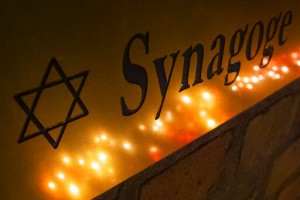
FILE - In this Friday, Oct. 11, 2019 file photo, candles reflect in an entrance sign after a human chain with lights was formed around the Jewish synagogue during the Sabbath celebrations in Halle (Saale), Germany, following an attack on the synagogue on Yom Kippur 2019. As Jews around the world gather Sunday night to mark the beginning of Yom Kippur, many in Germany remain uneasy about going together to their houses of worship to pray, a year after a white-supremacist targeted a synagogue in the eastern city of Halle on the holiest day in Judaism. (AP Photo/Jens Meyer, file)