Judge Amy Coney Barrett, President Donald Trump’s nominee for the Supreme Court, has been on the 7th U.S. Circuit Court of Appeals since 2017.
Her short tenure as a judge has led to few noteworthy or controversial opinions. She has, however, signed onto several decisions that are sure to be questioned in a possible confirmation fight.
Here are summaries of some of her notable opinions:
ABORTION
Barrett has twice joined dissenting opinions asking for decisions blocking laws enacted by abortion opponents to be thrown out and reheard by the full appeals court.
Last year, after a three-judge panel blocked an Indiana law that would make it harder for a minor to have an abortion without her parents being notified, Barrett voted to have the case reheard by the full court.
In July, the Supreme Court threw out the panel’s ruling and ordered a new look at the case.
In 2018, a three-judge panel ruled that Indiana laws requiring that funerals be held for fetal remains after an abortion or miscarriage and banning abortions because of the sex, race or developmental disability of a fetus were unconstitutional.
Barrett was among four judges who wanted the full court to weigh in and suggested that the laws, signed by then-Gov. Mike Pence, might be constitutional.
Supreme Court abortion decisions “hold that, until a fetus is viable, a woman is entitled to decide whether to bear a child. But there is a difference between ‘I don’t want a child’ and ‘I want a child, but only a male’ or ‘I want only children whose genes predict success in life,’” Judge Frank Easterbrook wrote for the dissenting judges.
Barrett also joined the part of the opinion on the fetal remains law. “Many states have laws that prescribe how animals’ remains must be handled,” Judge Frank Easterbrook wrote for the dissenters. “The panel has held invalid a statute that would be sustained had it concerned the remains of cats or gerbils.”
Last year, the Supreme Court reinstated the fetal remains law, but not the ban on abortions for race, sex and developmental disabilities.
GUNS
In a dissent in the 2019 gun-rights case of Kanter v. Barr, Barrett argued that a conviction for a nonviolent felony — in this case, mail fraud — shouldn’t automatically disqualify someone from owning a gun.
The two judges in the majority agreed with Trump administration arguments that the defendant, Rickey Kanter, could not own a gun under federal or Wisconsin law because of his criminal conviction.
Barrett used most of her 37-page dissent to lay out the history of gun rules for convicted criminals in the 18th and 19th centuries, consistent with her embrace of interpreting laws and the Constitution according to the meaning they had when they were adopted.
Barrett wrote that “while both Wisconsin and the United States have an unquestionably strong interest in protecting the public from gun violence, they have failed to show, by either logic or data that disarming Kanter substantially advances that interest.”
She said that her colleagues were treating the Second Amendment as a “second-class right, subject to an entirely different body of rules than the other Bill of Rights guarantees.” Barrett quoted from a 2010 opinion by Justice Samuel Alito that extended gun rights, but the phrase also has been used more recently by Justice Clarence Thomas and other conservatives to complain that the Supreme Court has shied away from recognizing gun rights.
CAMPUS SEXUAL ASSAULT
Barrett wrote a unanimous three-judge panel decision in 2019 making it easier for men alleged to have committed sexual assaults on campus to challenge the proceedings against them.
The case involved allegations by a female student at Purdue University that her boyfriend had sexually assaulted her. The students were identified in court documents as John and Jane Doe.
John Doe sued in federal court claiming sex discrimination after Purdue suspended him for a year and took away his Navy ROTC scholarship. Barrett concluded Purdue’s process was unfair and allowed his lawsuit to continue.
“The case against him boiled down to a ‘he said/she said’ — Purdue had to decide whether to believe John or Jane,” Barrett wrote.
The judge criticized the university official who ended up siding with the female student. “Her basis for believing Jane is perplexing, given that she never talked to Jane. Indeed, Jane did not even submit a statement in her own words,” Barrett wrote.
IMMIGRATION
Barrett was in dissent in June when her two colleagues on a 7th circuit panel put on hold, just in Chicago, the Trump administration policy that could jeopardize permanent resident status for immigrants who use food stamps, Medicaid and housing vouchers.
Under the new policy, immigration officials can deny green cards to legal immigrants over their use of public benefits.
She wrote that existing immigration law and Clinton-era welfare reform had already limited public assistance to noncitizens. The administration was just using leeway those laws had given it, Barrett wrote. The objections of immigrants and their advocates “reflect disagreement with this policy choice and even the statutory exclusion itself. Litigation is not the vehicle for resolving policy disputes,” she wrote.
ACCESS TO A LAWYER
Barrett dissented in the case of a Wisconsin man who admitted that he fatally shot his wife seven times but argued that he had been provoked, making his crime second-degree homicide instead of first-degree homicide, which carries a higher penalty.
A federal judge reviewed the provoking claim in a pretrial hearing without prosecutors present and without allowing the lawyer of defendant Scott Schmidt to speak. The judge rejected Schmidt’s claim of provocation, and he was convicted of first-degree homicide and sentenced to life in prison. However, a 7th Circuit panel overturned that decision, saying that Schmidt had been denied his Sixth Amendment right to counsel.
Barrett, in her dissent, disagreed that the pretrial hearing where the judge questioned Schmidt about his provocation claim was a situation that required Schmidt’s lawyer and said the Supreme Court has never extended the right to counsel outside an adversarial proceeding.
The Supreme Court’s “’critical stage’ precedent deals exclusively with adversarial confrontations between the defendant and an agent of the state,” she said.
She added: “Perhaps the right to counsel should extend to a hearing like the one the judge conducted in Schmidt’s case. But (federal law) precludes us from disturbing a state court’s judgment on the ground that a state court decided an open question differently than we would — or, for that matter, differently than we think the (Supreme) Court would.”
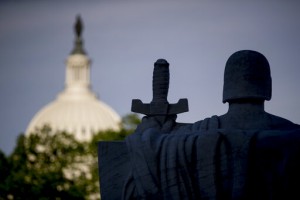
FILE - In this May 4, 2020, file photo the Dome of the U.S. Capitol Building is visible from the steps of the the Supreme Court in Washington. (AP Photo/Andrew Harnik, File)