MEXICO CITY (AP) — There were mass cremations of bodies; entire families died and the inhabitants of the city, afraid to pull their bodies out, simply collapsed their homes on top of them to bury them on the spot.
The scene, beyond even the current coronavirus pandemic, was a scourge brought 500 years ago by Spanish conquistadores and their servants that exploded in Mexico City in September 1520.
Smallpox and other newly introduced diseases went on to kill tens of millions of Indigenous people in the Americas who had no resistance to the European illnesses. The viruses later spread to South America, and helped lead to the downfall and overthrow of empires like the Aztecs and Incas. And its lessons remain largely forgotten today.
Hernán Cortés and his band of a few hundred Spaniards had been kicked out of the Aztec capital of Tenochtitlan, today’s Mexico City, on June 30, 1520, by angry residents after the conquistadores took the emperor Moctezuma captive and he died.
But the Spaniards left behind Indigenous and African slaves they had brought with them from Cuba. Some of them were already infected with smallpox, and amid the harsh conditions in the capital — Cortés and his allies blockaded the city after the June defeat.
Historian Miguel León Portilla in his book “The Vision of the Conquered” cites chroniclers who described it as “a great plague … a huge destroyer of people.” Cuitláhuac, Moctezuma’s successor, died of the disease in 1520.
The Aztecs, or Mexicas as they were known, tried long-trusted remedies to combat the unknown disease. Like the coronavirus pandemic, that did not necessarily work out well.
They tried medicinal steam baths known as temezcales, a sort of sweat lodge, but because people were packed so tightly into the enclosed stone and mud chambers, the baths served only to propagate the disease more efficiently.
“It was a massive group contagion,” said medical historian Sandra Guevara,
Cortés and his men would reenter and conquer the disease-ravaged city a year later in August 1521.
By then, due to smallpox, battles and food shortages caused by the conquistadores’ blockade, there were so many rotting corpses in the street that Cortés briefly decided to move the Spaniards’ new capital to a town further south to avoid the pestilent smell.
Outside the Aztec capital, those Indigenous people who remained dealt with the first smallpox epidemic — and later plagues by that and other diseases wound up killing most of the pre-Hispanic population — by doing what they continued to do for centuries: retreat into hard-to-reach areas and try to block themselves off from the outside world.
During the coronavirus pandemic, many Indigenous communities retreated to the centuries-old ways, setting up roadblocks to prevent outsiders from entering their villages.
“We are living through today something like what they (our ancestors) might have felt,” Guevara said.
Apart from failed cures and almost medieval strategies, it remains unclear how much humanity has learned from one of the greatest mass die-offs due to epidemics.
In the case of smallpox, humanity won the battle: the disease gave rise to the first successful vaccine in 1796, and the World Health Organization declared the disease eradicated outside laboratories in 1980.
But such victories bred arrogance, experts say.
“In the last 50 years, a certain arrogance has prevailed in the medical community, thinking that we had brought all the infectious diseases under control,” said José Esparza, a professor of medicine at the University of Maryland Institute of Human Virology. “This pandemic has given us a big surprise.”
Humanity has learned lessons from diseases, Guevara notes. Cholera taught us the importance of clean water and sanitation; AIDS changed sexual behavior.
“The important thing is how we deal with it,” said Guevara. “We have to learn that humanity cannot control everything.”
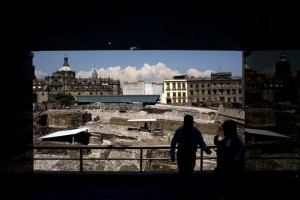
FILE - In this Friday, Aug. 7, 2015 file photo, a worker stands in front of ongoing excavations at the Templo Mayor archeological site, directing people into the adjoining museum in downtown Mexico City, once the Aztec capital of Tenochtitlan. In light of the 2020 COVID-19 pandemic, it remains unclear how much humanity has learned from one of the greatest mass die-offs due to the smallpox epidemic, which gave rise to the first successful vaccine in 1796. (AP Photo/Rebecca Blackwell, File)