Australia’s coronavirus epicenter records no new cases as the US and Western Europe struggle to contain the pandemic
By Joshua Berlinger, CNN
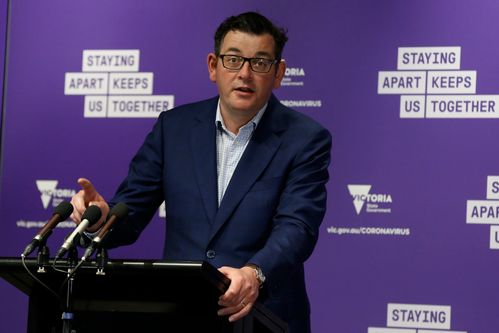
MELBOURNE, AUSTRALIA - SEPTEMBER 20: Victorian Premier Daniel Andrews speaks at the daily briefing on September 20, 2020 in Melbourne, Australia. Victoria has recorded 14 new coronavirus cases and five deaths in the past 24 hours, the second day in a row of daily new cases under 30 after 21 cases were recorded on Saturday. It is the lowest case numbers for Victoria since June 24 where 20 cases were reported. Metropolitan Melbourne remains under stage 4 lockdown restrictions, with people only allowed to leave home to give or receive care, shopping for food and essential items, daily exercise and work while an overnight curfew from 8pm to 5am is also in place. The majority of retail businesses are also closed. Other Victorian regions are in stage 3 lockdown. The restrictions, which came into effect from 2 August, were introduced by the Victorian government as health authorities work to reduce community COVID-19 transmissions across the state. (Photo by Darrian Traynor/Getty Images)
Melbourne, the city at the epicenter of Australia’s coronavirus epidemic, will move out of lockdown this week after the Victoria state health department on Sunday reported no new cases and no deaths due to the virus for the first time in more than four months.
Announcing the relaxation of restrictions at a news conference on Monday, Victoria Premier Daniel Andrews said starting on Tuesday at 11:59 p.m., Melbourne residents will be allowed to leave their homes and most businesses in the state can reopen with restrictions on the number of people.
“With 0 cases and so much testing, we are able to say that now is the time to open up. Now is the time to congratulate every single Victorian who has stayed the course,” Andrews said.
The remarkable milestone of no new cases comes just months after Andrews declared a “state of disaster” to stem an outbreak that saw as many as 725 people in the state test positive for the virus in a single day.
The steep decline in cases has allowed the government to lift major social distancing measures that have been in place for weeks.
As cases began skyrocketing this summer, Andrews put in place the type of strict anti-epidemic measures that governments in Western Europe and the United States have been hesitant to enact out of fear of damaging the economy and trampling on civil liberties.
From a public health standpoint, Andrews’ decision appeared to have worked. While cases in Europe continue to skyrocket to record-breaking levels and US President Donald Trump’s chief of staff said the United States “will not be able to contain the pandemic,” Victoria appears to have done just that.
East Asian governments including those in China, South Korea and Taiwan have not needed to put in place such restrictions because early efforts to contain the virus focused on testing and contact tracing, combined with the readiness of their respective populations to wear masks and follow social distancing guidelines, which helped keep the pandemic in check.
Andrews said Victoria was able to rein in the pandemic because of the public’s willingness to endure hardship, listen to the science and follow the rules.
“I could not be prouder than I am today to lead a state that has showed the courage, the compassion, and the character to get this job done. But it is not yet absolutely finished,” he said.
“We have to be vigilant in the weeks and months … until a vaccine comes, there is no normal. There is only Covid-normal.”
Under the relaxed measures, staff are allowed to immediately return to their businesses in order to prepare for customers and put in place anti-epidemic measures.
Some restrictions, including a 25-kilometer (15-mile) limit on travel and an internal border between Victoria and metropolitan Melbourne, will remain in place until November 8.
Though Victoria, as of Monday, accounts for at least 20,300 of Australia’s more than 27,500 cases and 817 of the country’s 905 deaths, the number of active cases in Victoria has steadily declined in the past 30 days. The number of new infections has been in single digits since October 13 and has not exceeded 20 in the past month.
Australian Prime Minister Scott Morrison congratulated the state for the drop in Covid-19 cases and lauded Victorians for the making “great progress in reducing the rate of Covid-19 infection.”
“They have played their part and sacrificed much in the pursuit of reaching those targets in the belief restrictions would be eased,” he said.
Morrison added that Victoria would open state borders by Christmas. They were closed as part of the federal government’s response to the pandemic.
Winter lockdown
Victoria and its capital Melbourne faced Australia’s worst outbreak of Covid-19 this Australian winter.
Andrews declared the disaster in early August as Victoria was recording hundreds of cases per day, while the federal government closed the state’s borders to non-essential travel. The state’s government instituted some of the strictest social distancing measures in the country, including placing Melbourne’s 5 million residents under a seven-week lockdown and barring nearly all trips outdoors.
Andrews said Monday the government was not going to be “pushed by the loudest voices” to reopen before public health experts deemed it was safe to do so.
The draconian restrictions were kept in place for quite some time, even as the state’s case count and the number of fatalities began dropping.
By late September, cases has declined to low double-digits, allowing the government to lift Melbourne’s curfew.
Andrews hinted earlier this month that authorities were considering lifting more restrictions if trends continued in the right direction. However, a small cluster of cases in Melbourne’s northern suburbs prompted him to put in place a “cautious pause” in order to test more than 4,000 residents, further delaying reopening.
Nearly all tests have come back negative. Andrews said health authorities can now rule out widespread community transmission.
“It was worth waiting to be sure,” he said.
A previous version of this story misstated Victoria Premier Daniel Andrews’ political affiliation. This has been corrected.