China uproots ethnic minority villages in anti-poverty fight
By SAM McNEIL - Associated Press
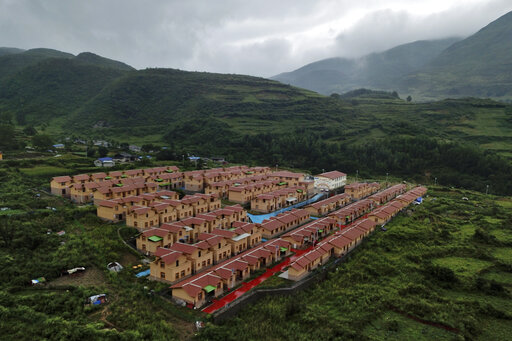
An aerial view shows new village houses built by the Chinese government for ethnic minority in Ganluo county, southwest China's Sichuan province on Sept. 10, 2020. China's ruling Communist Party says its initiatives have helped to lift millions of people out of poverty. Yi ethnic minority members were moved out of their mountain villages in China’s southwest and into the newly built town in an anti-poverty initiative. (AP Photo/Sam McNeil)
CHENGBEI GAN’EN, China (AP) — Under a portrait of President Xi Jinping, Ashibusha sits in her freshly painted living room cradling her infant daughter beside a chair labeled a “gift from the government.”
The mother of three is among 6,600 members of the Yi ethnic minority who were moved out of 38 mountain villages in China’s southwest and into a newly built town in an anti-poverty initiative.
Farmers who tended mountainside plots were assigned jobs at an apple plantation. Children who until then spoke only their own tongue, Nuosu, attend kindergarten in Mandarin, China’s official language.
“Everyone is together,” said Ashibusha, 26.
While other nations invest in developing poor areas, Beijing doesn’t hesitate to operate on a more ambitious scale by moving communities wholesale and building new towns in its effort to modernize China. The ruling Communist Party has announced an official target of ending extreme poverty by the end of the year, ahead of the 100th anniversary of its founding in 2021.
The party says such initiatives have helped to lift millions of people out of poverty. But they can require drastic changes, sometimes uprooting whole communities. They fuel complaints the party is trying to erase cultures as it prods minorities to embrace the language and lifestyle of the Han, who make up more than 90% of China’s population.
At a time when the party faces protests by students in China’s northern region of Inner Mongolia over plans to reduce the use of the Mongolian language in schools, officials want to show they are sensitive to minority cultures.
They invited reporters to visit Chengbei Gan’en and four other villages — Xujiashan, Qingshui, Daganyi and Xiaoshan — that are part of what authorities see as a successful development project for the Yi in Sichuan province’s Liangshan prefecture.
The initiative is one of hundreds launched over the past four decades to spread prosperity from China’s thriving east to the countryside and west.
Mass relocations still are carried out because some mountainous and other areas are too isolated, said Wang Sangui, president of the China Poverty Alleviation Research Institute of Renmin University in Beijing.
“It is impossible to solve the problem of absolute poverty without relocation,” he said.
In Sichuan, which includes some of China’s poorest areas, 80 billion yuan ($12 billion) has been spent to date to relocate 1.4 million people, according to Peng Qinghua, the provincial party secretary. He said that included building 370,000 new homes and over 110,000 kilometers (68,000 miles) of rural roads.
In Chengbei Gan’en, 420 million yuan ($60 million) was spent to build 1,440 apartments in 25 identical white buildings, a clinic, a kindergarten and a center for the elderly.
Craftspeople sell silver jewelry, painted cow skulls and traditional clothing that are popular with Han tourists. Yi women can study to become nannies, a profession in demand in urban China, in classes taught with pink plastic dolls.
Roadside signs call on people to speak the official language. “Mandarin, please, after you enter kindergarten.” “Speak Mandarin well, it’s convenient for everyone.” “Everyone speaks Mandarin, flower of civilization blooms everywhere.”
Murals on buildings depict the Yi with members of the Han majority in amicable scenes. One shows a baby holding a heart emblazoned with the ruling party’s hammer-and-sickle symbol.
In one village, Xujiashan, annual household income has risen from 1,750 yuan ($260) in 2014 to 11,000 yuan ($1,600), according to its deputy secretary, Zhang Lixin.
Development initiatives can lead to political tension because many have strategic goals such as strengthening control over minority areas by encouraging nomads to settle or diluting the local populace with outsiders.
In Inner Mongolia, students boycotted classes this month over plans to replace Mongolian-language textbooks with Chinese ones.
The party faces similar complaints that it is suppressing local languages in Tibet and the Muslim region of Xinjiang in the northwest. Xinjiang’s Han party secretary said in 2002 the language of the Uighurs, its most populous ethnic group, was “out of step with the 21st century” and should be abandoned in favor of Mandarin.
The party boss for Liangshan prefecture acknowledged its initiative isn’t purely economic.
Authorities want to eliminate “outdated habits,” said the official, Lin Shucheng. He listed complaints about extravagant dowries, too many animals butchered for funerals and poor hygiene.
“We are fighting against traditional forces of habit,” he said.
At the same time, ruling party officials say they are preserving Nuosu, a Yi language, through bilingual education in schools and government support for a Nuosu newspaper and TV show.
“We protect and promote the learning, use and development of the Yi language,” the provincial party secretary, Peng, told reporters.
The party might be willing to promote Nuosu because, unlike in Tibet or Xinjiang, the Yi demand no political change, said Stevan Harrell, a University of Washington anthropologist who has spent more than three decades visiting and studying the region.
“There is no ‘splittism’ in Liangshan,” Harrell said, using the party’s term for activists who want more autonomy for Tibet and Xinjiang.
“So it is kind of safe to have the Yi language as a medium of education,” said Harrell. “And it scores points for the government against those people who rightly point out that Uighur and Tibetan languages are being severely suppressed.”
The region, like the rest of China, reeled from the coronavirus outbreak, said Lin, the Liangshan party boss. But he said anti-poverty work was back on track and authorities were confident they could meet official deadlines.
Older villagers welcome the jump in living standards.
“You can eat whatever you like now,” said Wang Deying, an 83-year-old grandmother of five. “Now even the pigs eat rice.”
AP researchers Yu Bing in Beijing and Chen Si in Shanghai contributed to this report.