Efforts afoot to save South’s disappearing grasslands
By TRAVIS LOLLER - Associated Press
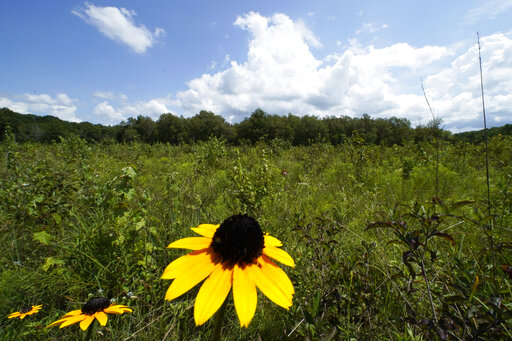
A black-eyed Susan flower grows among a variety of plants in an open grassland area at the May Prairie State Natural Area on Aug. 20, 2020, in Manchester, Tenn. Across much of the South, at least 90% of the native grasslands have been lost, the Southeastern Grasslands Initiative estimates. (AP Photo/Mark Humphrey)
NASHVILLE, Tenn. (AP) — In the early 2000s, a harvest of pine trees on Tennessee’s Cumberland Plateau led to a remarkable discovery. Once sunlight hit the ground, the seeds and rootstock of native grasses and wildflowers that had lain dormant for decades began to spring to life.
The area was originally part of vast patchwork of Southern grasslands that today hang on only in tiny remnants, many times in rights-of-way next to roads or under power lines. They have often been an afterthought in conservation, if they were even thought of at all. But that is starting to change.
In Tennessee, where the pine trees were cleared, wildlife officials now maintain about 4,000 acres of grassland in the Catoosa Wildlife Management Area with controlled low-temperature burns. Along with the native plants, grassland loving animals have returned, including ground-nesting birds and rabbits.
Meanwhile, the Southeastern Grasslands Initiative is working to restore thousands of acres of other grasslands while also developing a seed bank, discovering new species and leading volunteers to search for remnants.
Across much of the South, at least 90% of the native grasslands have been lost, the initiative estimates. Despite their diminished range, Southern grasslands are still home to an incredible diversity of plants and animals — greater than the surrounding forests, which are often a top priority for conservation. One researcher documented over 90 species of bees on a single 50-acre remnant (20 hectares) preserved under power lines in Mississippi’s Black Belt. Taken as a whole, the remaining Black Belt prairie is home to more than 1,000 species of moths.
Part of the reason grasslands are so easily lost is because many people don’t recognize them as anything special, said Theo Witsell, an ecologist who cofounded the conservation initiative in 2018.
“You can have an ancient grassland, thousands of years old, preserved in some little hay meadow that was never planted,” he said. “They’re isolated and unrecognized unless you know plants.”
Grasslands come in various forms — wetland bogs, rocky barrens, lush prairies, even woodlands — anywhere the tree cover is sparse enough to allow grasses, flowers and other small plants to flourish. That’s why the longleaf pine savanna that once stretched more than 140,000 square miles (364,000 square kilometers) from Virginia to Texas can properly be considered a grassland although its dominant visual feature is a tree.
Famed naturalist E.O. Wilson has written that the southern grassland biome is “probably the richest terrestrial biome in all of North America.” It is also one of the most highly endangered. With habitat loss, many animals have all but disappeared from the landscape, including the monarch butterfly, Eastern meadowlark and Bobwhite quail. And the loss is ongoing.
Tracking down remnants to preserve native grasslands sometimes requires as much detective work as botanical knowledge. Tools the initiative’s scientists employ include old maps with clues in place names like Prairie Creek. There are also old land surveys with boundaries marked by rock piles where no large trees were available as landmarks. And they have a team of volunteers scouring more than 4,000 miles of old roadsides in search of native plants.
Initiative co-founder Dwayne Estes is a botany and ecology professor at Austin Peay State University, where it’s based. He recently paid a visit to 900 acres (364 hectares) of former farmland in Nashville he’s surveying for the city’s parks department with the goal of restoring about a third to native grasslands.
Asked what type of grassland it was, Estes said there’s no name because it was never formally described in scientific literature. Like many Southern grasslands, it was lost before it could be recorded.
“Nearly every single thing around us has changed,” he said. But he pointed to a few sun-loving native plants such as MacGregor’s wild rye and a gnarled chinkapin oak, saying they offer clues about the land hundreds of years ago.
Much of the land the initiative hopes to restore lies in private hands. And Estes said knowing the cultural as well as botanical history helps him when talking to farmers about conservation. He can tell them a story about what once grew there, and relate that to what people lived there and where they chose to build homes, hunt and farm.
Among the private landowners wooed are former U.S. Senate Majority Leader Bill Frist, a Tennessee Republican, and his wife Tracy, who own a 900-acre (364 hectares) farm in New Castle, Virginia. Tracy Frist raises grass-fed cattle on the abundant native grasses. A Virginia Tech graduate student is studying the grasses’ nutritional value and its effect on the cattle and the meat they yield. Tracy Frist said. And Estes is helping the Frists understand how to best manage their land through grazing and controlled fire.
Already, they are maintaining a butterfly corridor with milkweed for migrating monarchs and a wetland with a large beaver pond.
“I didn’t know the diversity and history of the grasses or appreciate how important they are to migration and also biodiversity,” Tracy Frist said.
Even for scientists, native grasslands still hold surprises.
“In the last six years I’ve described 25 new species of grasshopper,” said JoVonn Hill, interim director of the Mississippi Entomological Museum and professor at Mississippi State University .
The first new grasshopper he discovered was in a Tennessee cedar glade near the city of Lebanon. “That’s an area that’s been well studied by botanists since the 1800s,” Hill said. “But literally my first step, I stepped out of the car, and I saw a grasshopper jump up that looked like one I’d never seen before.
“Right here in the Southeast we have species we haven’t found yet.”