Earlier this year, Gabrielle Perry went on one of the best dates she’d ever had.
She was impressed by her date’s life experiences and conversation. She had a lovely time and agreed to meet him again.
Then the onslaught of threats began.
The man started texting her a torrent of personal information — the make and model of her car, her parents’ names and birthdays and other personal information she had never given him. Then, he threatened to kill her and her mother.
She didn’t understand why the man she’d met flipped like that. But she quickly found all the information he’d quoted on a website that pulled from public voter registration rolls. It had more than 75 million voters’ records from 15 states plus Washington DC.
“At first I wasn’t even entirely convinced I was being stalked,” Perry, an epidemiologist in Louisiana, told CNN. “I slept with my 9mm [handgun] in my hand and a weight in front of the door for months because of what he did.”
Nearly every state makes its voter registration records public. In a few, that information is easily turned up by a search through an online database. In some cases,third-party websites compile those details so they’re even easier to find.
It was startlingly easy for a man to find Perry’s personal information and use it to threaten her.
It’s that fear — of being found, of being harmed — that keeps many abuse victims from even registering to vote.
“People don’t think about their safety with something so simple as voter registration,” said CarolAnn Peterson, an adjunct associate professor at the University of Southern California’s School of Social Work. “But that’s a lot of information for somebody to have.”
For abuse victims, privacy is paramount
Victims of abuse already struggle to engage in democracy. Their abuser may keep their ballot from them, force them to vote for a candidate they don’t support or even stop them from registering to vote, Peterson said. So when survivors escape those relationships, when their privacy is paramount to their survival, voting could compromise their safety. That applies to victims of stalking as well.
“For victims of domestic violence, voting is suppressed because they can’t trust to have their names on voter registration rolls. We have to find ways that they can safely vote,” Peterson told CNN. “It just makes this one more barrier to be able to find a way to get out the vote.”
Voter registration is rarely confidential
In all but a few states, voter registration information is public record.
It’s almost always available to political parties, candidates and members of the media upon request, but members of the public seeking those records can view them online or in person in every state. (The exceptions are California, Indiana, Maine, Wyoming and North Dakota, which typically don’t provide information to people without a political, legal or “scholarly” reason to access it, according to the National Conference of State Legislatures.)
Some states charge a fee to access the information, and others only provide the information in person at a state or county office.
The amount of information provided by states varies, too, though most of them disclose at least a voter’s full name and address.
In many cases, the information can be combined to create, what the National Network to End Domestic Violence calls, “enhanced voter records.” Those profiles are compiled by data brokers who comb through other public records and social media sites to create a more complete record about a voter.
With allthis information in tow, domestic violence survivor advocates say, an abuser can resume their torment of a survivor who’s escaped them. They’ll know where their former partner’s voting precinct is, so it’s possible they can show up on Election Day. They’ll know where the survivor lives. They may even have access to a survivor’s phone number in this way.
“When you intimidate or when you keep someone from voting, that’s a loss of their fundamental right,” said Ruth Glenn, president and CEO of the National Coalition Against Domestic Violence. It harms democracy, she said, when survivors and victims are disenfranchised.
Abuse is pervasive in the US. According to the National Coalition Against Domestic Violence, 1 in 4 women and 1 in 9 men will experience rape, physical violence or stalking by an intimate partner.
The 2020 presidential election has been called the most important of our lifetime. Activists, politicians, celebrities and even typically apolitical brands have encouraged every American to vote or risk four years with a candidate they don’t support. But the current system of voter registration doesn’t account for those survivors’ safety, said Glenn, the president and CEO of the coalition.
Shaming survivors of violence for not voting is perpetuating another form of violence against them and effectively blames them for the harm they endured, she said.
It’s not that survivors willfully refuse to vote, Glenn said — they want to make their voices heard. But they also fear for their lives.
“From a survivor perspective, survivors want to be involved,” she said. “They will be creative and find ways to be involved, even if they have to hide where they are because they’ve gotten their freedom.”
Shaming victims of abuse is particularly dangerous now during the pandemic, she said, when advocates and anti-violence organizations believe that abuse has surged. With victims stuck in the same home as their abusers during a period of extreme stress and widespread economic depression, it’s possible that a greater number of victims are being abused, and it’s more difficult than ever for advocates to get to them.
Because it’s so challenging to assist victims, few of them know about solutions.And there are some solutions.
Most states have a solution to help survivors vote safely
Florida’s public records laws are some of the most lax in the US, and that extends to voter registration information.
But Florida is one of 38 states with an address confidentiality program, per the National Center for Victims of Crime, so survivors of abuse can securely receive mail and keep their address private.
In states like Florida and Louisiana, where Perry is based, victims can submit a sworn statement to the state office that heads the program that states they’re a victim of domestic violence and request to make their address private. If approved, the victim will receive a new mailing address with a fictitious street number. The fictitious address is public, but their true address remains confidential, said Florida Sen. Lauren Book, a survivor advocate who chairs the state’s Committee on Children, Families and Elder Affairs.
Survivors enrolled in the program can register to vote securely, too, though they can’t vote in person. Their true addresses are used to ensure they’ll get their correct ballot, but their registration is entered manually in a locked file and not entered into the typical Florida voter registration system, Book said.
Survivors have their reasons to hesitate to participate
While Book said the process is “as secure as [the state] can possibly make it,” she understands why survivors may hesitate to participate. It’s an involved process and in many states requires providing documentation of abuse or legal actions against an abuser.
Book, herself a survivor of sex abuse, said making victims and survivors aware of their options so they can be empowered and enfranchised is essential — but survivors should never be made to do something that could compromise their safety.
“We see the world differently, in a different way,” she said. “Certain people should be protected in ways that maybe some people don’t think or understand. But you shouldn’t have to not exercise your right to vote and not be represented in government because you feel you could be beaten, hurt or killed.”
She still voted despite the risks
Back in Louisiana, there were parts of the year when Perry would sit in her driveway for half an hour, fearful to get out of the car and encounter the man she met in person only once.
Now, she only gives out a Google Voice number, which forwards calls and texts to her real phone number. And if her voter registration information changes, she knows to go to the third-party site where her information first appeared and ask for it to be removed.
Her stalker still sends her explicit photos from new, unknown numbers. She still sleeps with a weight in front of her door.
But Perry cast her ballot the first day early voting was available in Louisiana. She took the risk even though “domestic violence victims are the least of [election officials’] worries,” she said.
And because she refuses to let a stalker control her life — or her vote.
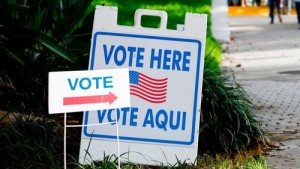
A woman walks past a "Vote Here" sign at Miami Beach City Hall in Miami Beach, Florida on October 19, 2020. - President Donald Trump lashed out at "stupid" critics from within his own party and called for unity on Sunday after growing Republican criticism and warnings of a "bloodbath" in the November 3 election. Trump issued the comments as he and his Democratic opponent Joe Biden hit the ground in crucial swing states in the final stretch before an election that opinion polls show the real estate mogul is at serious risk of losing. (Photo by Eva Marie UZCATEGUI / AFP) (Photo by EVA MARIE UZCATEGUI/AFP via Getty Images)