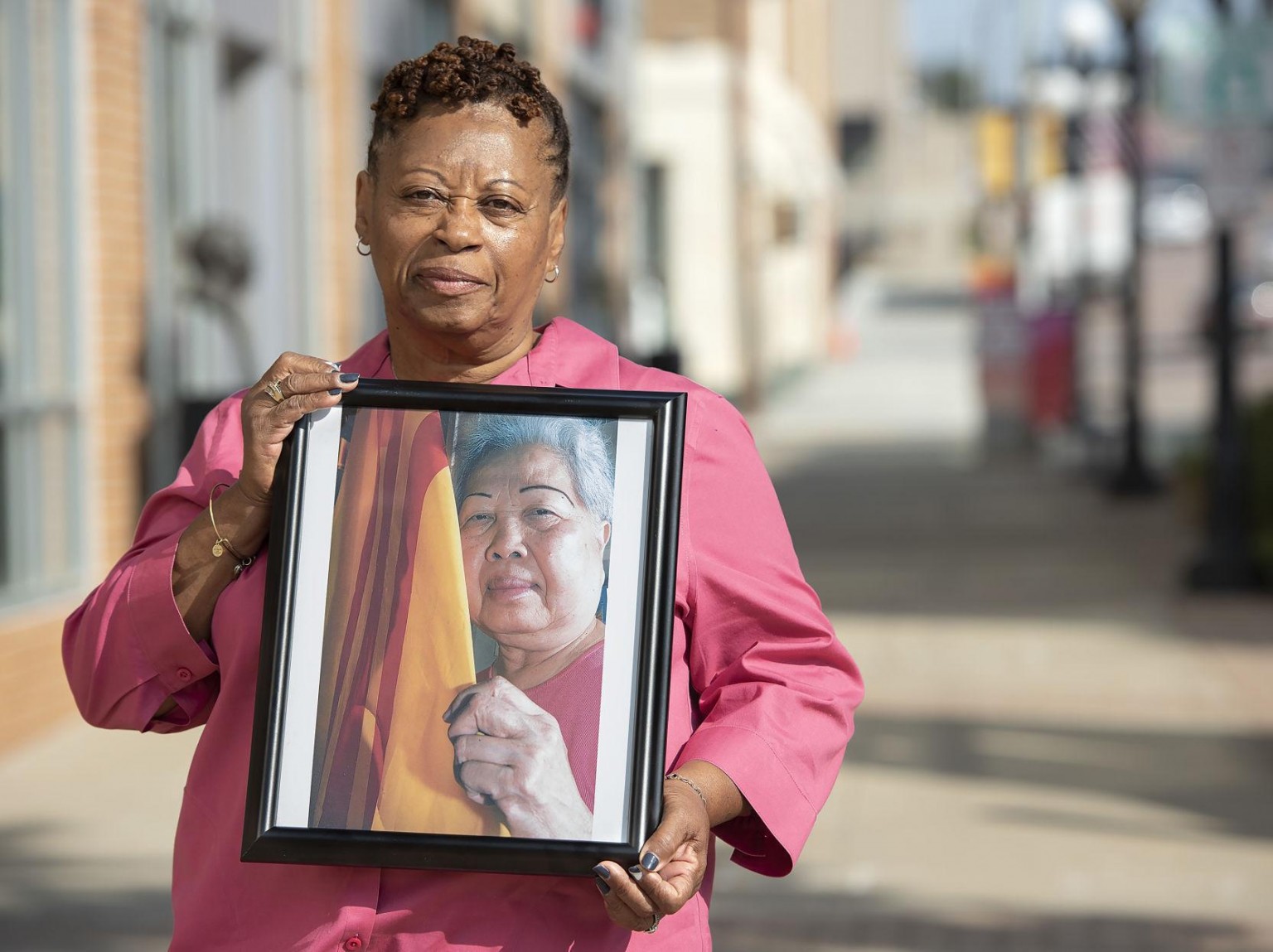
SIOUX CITY — Even though Hong Cuc Thi Nguyen’s health had been fragile for some time, her hospital stays always generated notice.
“We usually don’t see patients get that many visitors,” hospital staff told Tuyen Tran after 10 to 15 well-wishers would come to visit. “(Hong Cuc) must be a very important person.”
That was an understatement, said Tran, who had been friends with her for years.
“Hong Cuc was very well respected in Sioux City’s Asian community,” Tran said of his friend. “She was respected for her kindness and her knowledge.”
Hong Cuc died May 6 of complications of COVID-19 at MercyOne Siouxland Medical Center. She was 87.
Hong Cuc was born April 11, 1933, in a community about 50 miles south of Saigon, Vietnam. She earned a bachelor’s degree from the University of Saigon and a master’s degree from Ball State University, in Muncie, Indiana. After returning to Vietnam, she earned a doctorate.
At the time that Saigon fell to communist forces in 1975, Hong Cuc was working as a teacher for the Southeast Ministries of Education in Malaysia.
Emigrating to the U.S. in 1981, Hong Cuc arrived in Boulder, Colorado, before beginning a career at the University of Iowa’s Bilingual Center. Eventually, she came to Sioux City, where she worked for nonprofit agencies, including Lutheran Social Services and the Mary J. Treglia Community House.
Specifically, Hong Cuc provided translation services in Sioux City for Vietnamese immigrants who spoke little English.
“Hong Cuc did this for free,” Tran said. “All a person needed to do was ask for help and she’d do what she could.”
This help extended far beyond translating documents and papers.
“If a person had marital problems, family problems, whatever, she’d give you advice,” Tran said.
According to community activist Flora Lee, Hong Cuc helped Vietnamese immigrants relate to western culture while giving Sioux Cityans insight into Asian culture.
“Hong Cuc served as that bridge,” Lee said. “She understood things from both perspectives.”
Hong Cuc was, at times, a mentor, social worker, teacher and friend.
Single, Hong Cuc often spent holidays with Tran and his family.
“Hong Cuc was friends with my mom and they’d go to (Sioux City’s Pho-Mon) Buddhist Temple together,” Tran said. “Plus, we’d invite her over to Thanksgiving dinners and for our Fourth of July cookouts.”
Long after her retirement, she continued to volunteer her translating services.
“I thought you retired,” Tran would say to her. “She’d say no, ‘I’m too busy to retire.’ ”
In 2016, Hong Cuc was among the Siouxland leaders honored for their lifelong advocacy. A sculpture of her by artist Mark Avery is now a permanent part of the Martin Luther King Transportation Center.
“In my country, the teacher is not only respected by the student, she is also respected as a member of the community,” Hong Cuc told said in 2005.
“Hong Cuc was such a humble lady and was honored by the recognition,” Lee said. “I understand that she would have lunch with her friends at a downtown restaurant and, then, take them to see her sculpture because she was so proud of it.”
Even though they spoke on the phone occasionally, Lee said the last time she saw her was at the 2019 Women of Excellence banquet.
“When Hong Cuc was introduced, she received a standing ovation,” Lee said. “Nobody was more deserving of recognition than Hong Cuc.
“People may remember her as an advocate for Sioux City’s Asian community but she was much more than that. Hong Cuc was an advocate for everybody, regardless of who they were or the color of their skin.”