Jim McKee: Safe a reminder of Commonwealth and banking history
JIM McKEE
For the Lincoln Journal Star
COURTESY IMAGE
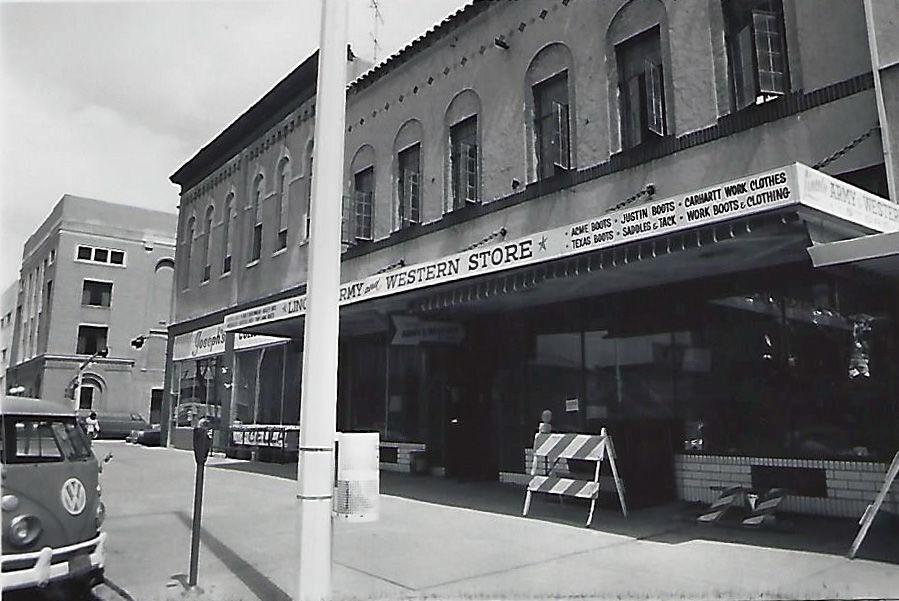
The east side of 11th Street between O and P streets is shown here in about 1975 with the Army & Western Store, pool hall and Chamber of Commerce building at the far left. Later this would be the location of Commonwealth Savings & Loan and today would be the west side of the Grand Theatre building.
In 1867 the northeast corner of 11th and O streets was occupied by Seth Robbin’s house. The following year the east side of 11th Street from O to P streets had one building, Leighton & Brown’s Drug Store. That building, whose lumber supposedly was brought by oxen from Nebraska City, was literally on the extreme east edge of what might have been termed Lincoln’s business district.
North and east of the drug store Block 41 was all vacant lots. Today the 11th Street elevation, as pictured in 1977, is the west wall of the Grand Theatre.
Isaac Raymond arrived in Lincoln in 1871 and within a year was joined by brothers Aaron, E. A. and H. C. Raymond, in business together as Raymond Brothers. Having dropped their retail grocery, they located their wholesale business on the southeast corner of 11th and P streets in the two-story building shown on the left in the above photo.
Although the basement extended under adjacent sidewalks, they were crowded and in 1885 built the extant building on the southeast corner of Eighth and O with the firm’s name becoming Raymond Brothers Clarke. Also, in 1885, the extant multi-storied brick and stone Richard’s Block was built where Leighton & Brown’s drug store had burned to the ground.
When the Raymond Brothers left 11th and P, the building was occupied by H. P. Lau Wholesale Grocers. That location proved short-lived as H. P. Lau moved to 219 N. Eighth St., now the location of the north portion of the Candy Factory building. By 1890, north of the Richards Block/Lincoln National Bank, was a vacant lot followed by eight small businesses, the largest being Lincoln Safe Deposit Company.
Fifty-four stockholders incorporated the Lincoln Savings Bank & Safe Deposit Company with W. E. Barkley, president, in 1888 by issuing $250,000 in capital stock. The business opened at 146 N. 11th. Although they were licensed as a savings bank and advertised as such, they were best known as having the “only system of safe deposit vaults in Lincoln” and the only Mosler, Bohman deposit vault in Nebraska, outside of Omaha.
The safe within the vault alone reportedly cost $15,000. The outer walls were constructed with 24 inches of brick followed by two inches of chrome steel then alternate, two-inch layers of iron and steel. The vault itself was 15½ by 17½ feet and weighted 27½ tons. The 1,000 individual boxes rented for $5 to $10 a year.
Lincoln Trust Co., then parent company of the Lincoln Safe Deposit Co., filed for bankruptcy in 1932. The following year C. H. Bickel formed the Commonwealth Company at the old safe deposit company’s location at 126 N. 11th and assumed the title as “home of the largest vaults in Lincoln.”
The corner building to the north at 148 N. 11th became Saratoga Billiards. S. E. Copple and relatives purchase Commonwealth Savings Co. in 1942 inheriting the safe deposit vault, which had then been joined by several banks which also offered safe deposit boxes.
By 1966, north of the alley and the Richards Block, were Commonwealth, the second floor Campus Hotel, a used furniture store with the corner as Joseph’s College of Beauty. The 1970s photo also shows Stan Dworsky’s Lincoln Army & Western Store at 146 N. 11th St., just south of the then beauty college.
Beginning in about 1980, the local housing market collapsed. Most Lincolnites remember 1983 in connection with the new building on the southeast corner of 11th and P streets which held Commonwealth Savings, built around the old safe deposit vault. After Commonwealth was unsuccessful in attempting to find a buyer, on Nov. 1, 1983, the state of Nebraska announced they were monitoring Commonwealth and later the same day, forced the firm into receivership.
Commonwealth had become “the largest industrial loan and investment company” of the 32 such firms in Nebraska. Their designation allowed them to pay higher interest on savings accounts, which attracted about 6,700 depositors. Depositors assumed that they were protected by the Nebraska Depository Institution Guaranty Co., which advertised each account as having $30,000 in “insurance.” The “insurance” fund however contained only a total pool of $3 million while, sadly, Commonwealth depositors investment totaled $65 million.
The last payout to depositors, partially with additional funds input by the state of Nebraska, was made in 2002 with account holders recovering about 56% of their savings.
Today most evidence of the buildings north of the Richards Block and all those along the south side of P Street between 11th and 12th streets has been replaced by the Grand Theatre. Inside the theater lobby however, the huge safe door still stands, perhaps the last visible relic of the 1880s safe deposit vaults and the Commonwealth Company.