Specter of election chaos raises questions on military role
By ROBERT BURNS and LOLITA C. BALDOR - Associated Press
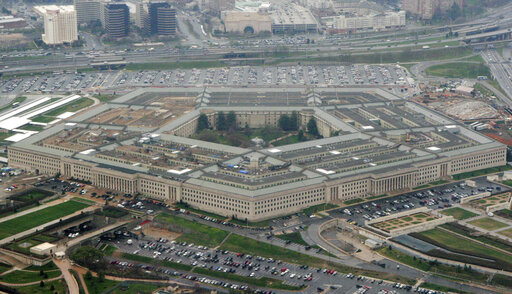
FILE - This March 27, 2008, file photo shows the Pentagon in Washington. The specter of election chaos in the United States is raising questions about whether voting, vote-counting or the post-vote reaction could become so chaotic that the military would intervene. (AP Photo/Charles Dharapak, File)
WASHINGTON (AP) — It’s a question Americans are unaccustomed to considering in a presidential election campaign: Could voting, vote-counting or the post-vote reaction become so chaotic that the U.S. military would intervene?
The answer is yes, but only in an extreme case. There is normally no need for the military to play any role in an election. The Constitution keeps the military in a narrow lane — defending the United States from external enemies. Civil order is left largely to civilian police. But there is an obscure law, the Insurrection Act, that theoretically could thrust the active-duty military into a police-like role. And governors have the ability to use the National Guard in state emergencies if needed.
The potential use of troops, either active duty or National Guard, at the polls or in post-election unrest has been discussed by governors and military leaders. The possibilities arise as President Donald Trump asserts without evidence that mail-in balloting will create election fraud and suggests that he might not accept an election loss. Stationing troops at polling places on Election Day — even if just to protect citizens as they vote — raises worries about voter intimidation.
Here are some questions and answers about possible military involvement in the election:
WHY WOULDN’T THE MILITARY GET INVOLVED?
Civilian control of the military is a bedrock principle of American democracy. It means that men and women in uniform answer to civilian leaders like the secretary of defense, and they stay apart from politics. They pledge their loyalty to the Constitution and the nation’s laws, not to a political party or a president.
Gen. Mark Milley, who as chairman of the Joint Chiefs of Staff is the nation’s top military officer, has told Congress the military is committed to staying apolitical and steering clear of any election role.
“In the event of a dispute over some aspect of the elections, by law U.S. courts and the U.S. Congress are required to resolve any disputes, not the U.S. military,” he said in written answers to questions from two Democratic members of the House Armed Service Committee. “I foresee no role for the U.S. armed forces in this process.”
Milley said service members must not get involved in the transfer of power after an election. In other words, don’t expect to see troops intervening if there is a dispute over who won.
WHAT COULD THE NATIONAL GUARD DO?
The military is made up of active duty, National Guard and Reserves. In all but extreme cases, active-duty troops are used for war to protect the nation, not against American citizens on domestic soil. National Guard units are in every state and are controlled by the governor, not the federal government.
Governors routinely mobilize their Guard members for emergencies, such as natural disasters, and they can use them to help enforce the law during events such as riots. But usually law enforcement takes the lead, and Guard forces support it. During civil unrest this year, governors used Guard troops to tamp down violence and provide security. They could do so again.
In a national emergency, such as the wars in Iraq and Afghanistan, a president can deploy the Guard in a federal status to support the active-duty military. The president has the authority to federalize the Guard for use in a domestic emergency, but there are questions about whether a state’s governor can try to block such a move.
WHAT ABOUT THE INSURRECTION ACT?
The president has the authority under the Insurrection Act of 1807 to dispatch active-duty military in states that are unable to put down an insurrection or are defying federal law. Under the law, the president can activate troops without a governor’s approval as long as specific conditions are met, such as if the violence is interfering with the execution of laws there.
Would potential post-election violence amount to an insurrection? That might be open to debate. It’s not clear if states could legally block any presidential use of the Insurrection Act.
In the last half-century, presidents have sent the military to Southern states to enforce school desegregation in the 1950s and 1960s, at times without gubernatorial consent. And troops were sent to Los Angeles when the California governor sought federal help during the 1992 riots. But it has not happened in connection with a presidential election in modern times.
In June, Trump considered invoking the Insurrection Act to use active-duty forces to quell unrest following the killing of George Floyd by Minneapolis police. Defense Secretary Mark Esper opposed using military troops for law enforcement. He argued publicly that the Insurrection Act should be invoked “only in the most urgent and dire of situations,” and added, “We are not in one of those situations now.”
Still, it would be unprecedented for military leaders to refuse to follow a presidential order invoking the act.
WHAT ABOUT SECURITY AT THE POLLS?
Democrats fear that Trump supporters will try to intimidate Democratic voters at polling places to scare them from voting. Trump added to those worries in the Sept. 29 debate, urging his supporters “to go into the polls and watch very carefully because that’s what has to happen.”
Several state leaders, including New York Gov. Andrew Cuomo, have raised the possibility of using Guard troops for security at the polls. Others used the Guard during primary elections. At times they wore civilian clothes and filled in for poll workers who were absent because of the COVID-19 pandemic. They also helped by cleaning polling places or directing traffic. But they must stay out of the polling process.
A uniformed military presence at the polls, however, raises worries.
Michele Flournoy, a Democrat who is considered a leading candidate to become the first female defense secretary if Joe Biden wins, said the Guard should be used only if police are overwhelmed. But she warned that using Guard troops at the polls could “be very intimidating to voters. … I hope we don’t get there as a nation.”