Thai protesters spark interest in 1976 university massacre
By JERRY HARMER and TASSANEE VEJPONGSA - Associated Press
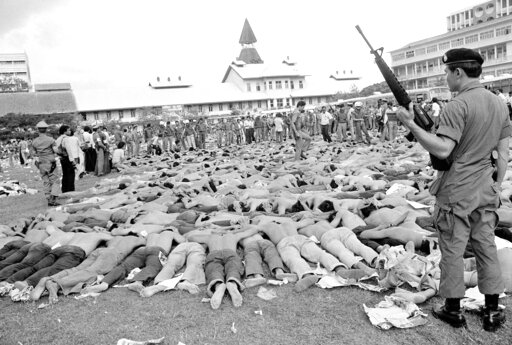
FILE - In this Oct. 6, 1976, file photo, police stand guard over leftist Thai students on a soccer field at Thammasat University, in Bangkok, Thailand. This year’s anti-government protests are seeking new elections, a more democratic constitution and an end to intimidation of political activists. Their speeches have repeatedly highlighted the 1976 tragedy, piquing the interest of the current generation in what their forebears faced. (AP Photo/Gary Mangkorn, File)
BANGKOK (AP) — Anti-government protests challenging the institutions of Thailand’s traditional ruling class are not just prompting intense debate about the country’s future. They are driving young people to delve into the darkest events of the not-so-distant past.
Academics and researchers say they’re seeing a surge in the number of people wanting to learn about a massacre of students 44 years ago that mainstream Thai history books ignore.
At Bangkok’s Thammasat University last week, students who were exploring connections to the troubled past took photographs for “then and now” comparisons to the bloodletting that took place on the campus on Oct. 6, 1976.
At another university in the capital, students hungry for information about the massacre scoured books to write an article for their online newspaper. Like many young Thais, they had known virtually nothing about it.
This year’s protesters are seeking new elections, a more democratic constitution and an end to intimidation of political activists. Their speeches have repeatedly highlighted the 1976 tragedy, piquing the interest of the current generation in what their forebears faced.
“We connect ourselves to the Oct. 6 event because it was when the state used force against those with different beliefs,” said third-year student Ruchapong Chamjirachaikul. “And we can see from the present that there are people and the student movement questioning the power of the established political institutions and the responses are also threats, use of force, and legal intimidation against those with different beliefs.”
Thailand in October 1976 was in ferment after a dictator ousted by a popular uprising three years earlier was allowed to return from exile to serve as a Buddhist monk. Deadly attacks on left-wing activists had escalated, and the government — unnerved by neighboring regimes in Vietnam, Cambodia and Laos falling under Communist rule — battled its own armed insurgency in the countryside.
Police that violent September had killed two state enterprise workers trying to paste up anti-dictatorship posters. Students at Thammasat University rallied — as they had been doing frequently since 1973 — to protest against the killings as well as the dictator’s return.
A student drama group staged a skit about the workers’ killings; right-wing newspapers and an army-operated radio station trumpeted that the skit was really a thinly disguised attack on the monarchy. Police and organized vigilante groups began gathering outside the university gates on the night of Oct. 5, and the next morning launched an all-out violent assault.
Official accounts say 40 students were killed but the actual toll is believed to be much higher.
Photos and film of incredible brutality — wild firing from heavy weapons directed into the campus, desecration of bodies dragged outside — left indelible images. But in time, the massacre became a non-event in Thailand, never included in school textbooks and fading quickly from the national consciousness.
That’s because it raises uncomfortable questions about who was responsible, some academics say, and because it contradicts the official narrative about the unity and goodness of Thai society.
“To dig into what happened in 1976, a lot of people are afraid that it will involve the ruling elite and its associates,” said Puangthong Pawakapan, a political science professor at Bangkok’s Chulalongkorn University. “They don’t want people to know about it. They want people to forget about it.”
Instead, they seem to be discovering it. An anniversary exhibition is drawing a steady stream of curious visitors; while online, the interest is a deluge. In August, as the contemporary protest movement gathered momentum, a Facebook page dedicated to the massacre registered 1.3 million visits. Visits to an online memorial site went up 13-fold.
“The younger generation is trying to understand what happened in the past,” said Patporn Phoothong, who curates the exhibition and the web pages. “They are not only questioning about the present, but looking into the past, trying to understand what happened, what were the problems, limitations and the structural problems that still cause issues today.”
Then, as now, the most explosive issue is the monarchy.
Some of today’s protest leaders are demanding significant reform of the royal institution, which is enshrined in law as a constitutional monarchy. For many conservative Thais, whose devotion to the throne is unconditional, that’s an insidious notion.
Veteran politician Warong Dechgitvigrom in August launched the group Thai Pakdee — Loyal Thais — with the declared goal of protecting the monarchy from “nation-haters.” He charged that raising the specter of 1976 is just a way to dupe the young into supporting revolution and the establishment of a republic, a goal explicitly denied by the protesters.
“So these people have to dig out the history of 40 years ago, that happened even before some of these youths were born, just to create hatred in our society,” he said.