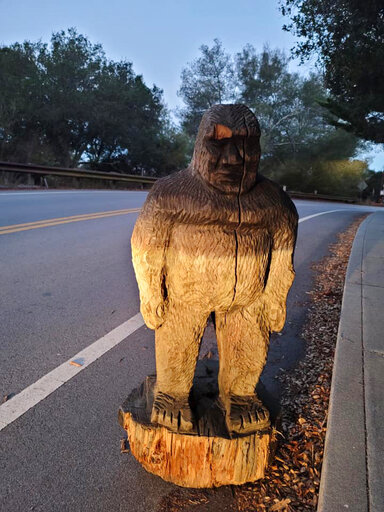
Uncredited - hogp, Scotts Valley Police DepartmentIn this photo provided by the Scotts Valley Police Department is a figure of Bigfoot that officers found on a roadway in the mountains north of Santa Cruz in Scotts Valley, Calif., Thursday, Nov. 12, 2020. The Scotts Valley Police Department says it was a little banged up but will be returned to its rightful place at the Bigfoot Discovery Museum. The Santa Cruz County Sheriff's Office had urged people to keep their eyes peeled for the 4-foot-tall wooden statue after it was stolen from outside the tiny museum in nearby Felton on Monday.
Here’s a look at visas, travel documents for individuals who are visiting or moving to the United States.
Facts
A visa is a travel document, affixed to a passport, granting citizens from foreign countries permission to enter the United States for a certain purpose, whether it’s a business trip, a family vacation or a student exchange program. Unlike passports, visas are issued by the country a traveler is intending to visit.
There are dozens of different types of visas covering an array of travel purposes and countries of origin.
Nonimmigrant visas are for visitors and temporary workers, and immigrant visas are for individuals who are relocating to the United States permanently.
A visa, approved by a consular officer in the traveler’s home country, does not guarantee admission to the United States. Officials from Customs and Border Protection (CBP), on behalf of the Department of Homeland Security (DHS), may deny a traveler permission to enter the United States for a variety of reasons, even if the individual has a valid visa.
Visitor visas can be used for multiple trips to the US while the visa is valid. CBP determines the length of stay for each visit. With most tourists and business travelers, the maximum length of stay per trip is six months. Visitors must return home when the approved length of stay ends, unless they’ve been granted an extension by US Citizenship and Immigration Services (USCIS).
The nonimmigrant visa application process begins with an online application called the DS-160 form. After submitting the form, applicants must call the nearest embassy or consulate to schedule an interview.
Some nonimmigrant visa applicants may have to pay an additional fee when their paperwork is approved, depending on their nationality and the fees imposed by their home country on travelers from the United States. This is called the principle of reciprocity.
B-1/B-2: These are visitor visas for travelers coming to the United States for business (B-1), tourism/vacation (B-2) or a combination of both. In 2019, the United States issued 5,297,439 B-1 and B-2 visas.
F-1:This visa is for students coming to the United States to attend grade school, college, seminary or other types of academic institutions. Students have 60 days to leave the United States after they have completed their studies. In 2019, the United States issued 364,204 F-1 visas.
J-1:Issued to participants in private sector cultural exchange programs. Cultural exchange categories include scholars, interns, teachers, seasonal workers, au pairs and professional trainees. In 2019, the United States issued 353,279 J-1 visas.
C-1/D: This visa is a combination crew member/transit visa issued to employees of airlines and cruise ships whose jobs involve continuous travel in and out of the United States. The C-1 visa is a transit visa, while the D visa is for crew members. Both visas are required for workers who come from other countries to work on a United States-based ship or aircraft. In 2019, the United States issued 285,477 C-1/D visas.
H-1B: This visa is for specialty workers, highly skilled professionals in fields including engineering, technology, medicine and higher education. There are three subcategories of H-1B visas. The H-1B1 is a free trade agreement visa for specialty workers from Chile and Singapore. The H-1B2 is for specialists who will work on projects for the Department of Defense Cooperative Research and Development program. The H-1B3 visa is for fashion models of “distinguished merit and ability.” In 2019, the United States issued 188,123 H-1B visas.
Immigrant Visas
The immigrant visa application process begins with a petition, which must be approved by US Citizenship and Immigration Services. Once the petition is approved, the applicant pays fees and files paperwork with the National Visa Center. After the documents are submitted, an interview is scheduled with an officer at the nearest US embassy or consulate. At the end of the interview, the applicant is told whether he or she has been approved or denied.
The main categories of immigrant visas are Immediate Relative (IR), Family Preference (F), Diversity Immigrants (DIV), Employment Preference (E) and Special Immigrants (SIV).
IR-1 and CR-1 (conditional residence): These visas are for spouses. An immigrant who has been married to a US citizen for less than two years is a conditional resident, with a CR-1 visa. In 2019, the United States issued 83,554 IR-1 and CR-1 visas.
IR-2 and CR-2 (conditional residence): This visa is for unmarried children (under the age of 21) of US citizens. In 2019, the United States issued 36,159 IR-2 and CR-2 visas.
IR-3: These visas are for orphans who are adopted abroad by US citizens. In 2019, the United States issued 841 IR-3 visas.
IR-4: This visa is for orphans who are brought to the United States and the adoption process is conducted domestically. In 2019, the United States issued 151 IR-4 visas.
IR-5: These visas are for parents of US citizens who are 21 or older. In 2019, the United States issued 63,442 IR-5 visas.
Family-Sponsored Preference (F1, F2A, F2B, F3, F4): The State Department issues a limited number of visas to individuals who have more distant family connections to US citizens. Family-sponsored preference visas also may be issued to relatives of individuals who are Lawful Permanent Residents (green card holders or LPR).
F1: This visa is for unmarried sons or daughters of US citizens and their children under the age of 18. In 2019, the United States issued 20,858 F1 visas.
F2: This visa is for spouses, minor children and unmarried sons and daughters (21 and older) of green card holders or LPRs. In 2019, the United States issued 86,236 F2 visas.
F3: These visas are for married sons and daughters of US citizens and their spouses. F3 visas may also be issued to grandchildren of US citizens who are under the age of 18. In 2019, the United States issued 23,074 F3 visas.
F4: This visa is for siblings of adult US citizens and their spouses or minor children. In 2019, the United States issued 60,770 F4 visas.
Diversity Immigrants (DV): Diversity visas are available to individuals who live in countries with low rates of immigration to the United States. These visas are granted via a lottery system. The countries eligible for diversity visas are grouped into six regions. An individual who lives in a country not included in the diversity program may qualify for the lottery if his or her spouse was born in one of the eligible countries. Diversity visa applicants must have a high school education or at least two years of qualifying work experience. In 2019, 45,889 DV visas were issued.
Employment-Based Preference (E1, E2, E3, E4, E5): The State Department issues about 20,000 employment preference immigrant visas annually. In most cases, the potential employer files an Immigrant Petition for an Alien Worker on behalf of the applicant. In some cases, an applicant who doesn’t have a specific job offer may file a petition on his or her own behalf. There are five categories for these visas.
E1: Priority workers qualify for this visa. Priority workers include people with “extraordinary ability” in science, the arts, business or sports; professors and researchers who are renowned worldwide, and managers or executives from overseas affiliates of US-based companies. In 2019, 2,223 E1 visas were issued.
E2: Applicants who have advanced college degrees or “exceptional abilities” qualify for this visa. E2 visas are for highly skilled professionals or those with “exceptional ability” in science, the arts or business. Most individuals applying for E2 visas must have a labor certificate approved by the Department of Labor. Generally, employers file petitions on behalf of workers. In some cases, however, applicants with “exceptional abilities” may self-petition for a visa. In 2019, the United States issued 3,497 E2 visas.
E3: This visa is for skilled and unskilled workers, as well as professionals who have at least a four-year college degree. All applicants must have petitions submitted by their prospective employers as well a labor certificate approved by the Department of Labor. In 2019, 13,028 E3 visas were issued.
E4: This visa is for special groups of immigrants who may apply for a visa without getting labor certification. E4 subgroups include clergy members, employees of the US government abroad and immigrant broadcasters. In 2019, 1,901 E4 visas were issued.
E5: This visa is for foreign nationals who are investing capital in US businesses. The minimum investment is $1 million for the visa; or foreign nationals who invest in a commercial enterprise in certain targeted geographic areas with high unemployment rates may get a visa for a $500,000 investment as a job-creating measure. In 2019, 7,889 E5 visas were issued.
Special Immigrants (SIV): Special immigrant visas are issued to several subgroups, including Iraqis or Afghans who worked on behalf of the government, Iraqi and Afghan translators, and green card holders who are returning to the United States after spending a year or longer abroad. In 2019, the United States issued 11,384 SIV visas.