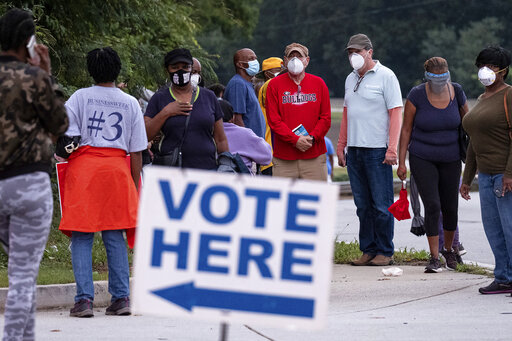
In the final days before the presidential election, the Supreme Court has been pelted with requests from parties in battleground states seeking last minute approval to change election rules, especially regarding whether mail-in votes can arrive after Election Day and still be counted.
The court, issuing some of the orders after hours, has navigated a minefield with justices seeking consensus and coherence where possible, hindered without the benefit of a full briefing schedule. The situation was complicated by the fact that emergency requests came in before and just after Justice Amy Coney Barrett took the bench.
On the face of it sometimes the orders seemed contradictory. In North Carolina, ballots can arrive up to nine days after Election Day; in Pennsylvania, ballots can arrive up to three days late — for now; and in Wisconsin, the court said ballots must be in by election night.
Some themes have emerged. It is now clear that four conservative justices are ready to take a sharp right turn when it comes to the power of state legislatures to set the rules for elections. In addition, Chief Justice John Roberts served as swing vote at times, but still worked to preserve the court’s institutional legitimacy, and the liberals on the bench again expressed their fear that the pandemic could disenfranchise voters in some states.
All the while, Barrett, Trump’s latest justice, has stayed out of the political fray for the moment.
Wisconsin: Mail-in ballots must be received by Election Day
A federal district court in Wisconsin had allowed ballots to be received up to six days after the election, but a federal appeals court had blocked the order. The high court upheld that block in a 5-3 ruling on Monday.
Here, Roberts’ role was critical, and he sided with the other four conservatives (the ruling came down before Barrett joined the bench). He explained that the federal district court had “intervened in the thick of election season” and intruded on the state lawmaking processes — which didn’t allow for extending the mail-in deadline. The court made clear that federal courts shouldn’t interfere to change state election rules so close to the election.
In concurring opinions, Justices Neil Gorsuch and Brett Kavanaugh sent strong signals about the power of state legislatures.
“The Constitution provides that state legislatures — not federal judges, not state judges, not state governors, not other state officials — bear primary responsibility for setting election rules,” Gorsuch wrote. That would make a big difference in post-election challenges particularly if the legislature and governor are from different parties. It conceives of a more robust role for the Supreme Court when reviewing lower courts.
Kavanaugh went farther. Echoing Trump, he said states are within their rights to set Election Day deadlines “to avoid the chaos and suspicions of impropriety that can ensue if thousands of absentee ballots flow in after election day and potentially flip the results of an election.”
Also key is that Kavanaugh referenced a three-justice concurrence in the 2000 Bush v. Gore decision suggesting that state courts may not have the final say when it comes to election rules. This could be a radical shift to the right in the years to come as it applies to voting rights.
The three liberals were left to stress that the courts had stepped in because of the pandemic and they feared voters would be disenfranchised during the pandemic.
Pennsylvania: Mail-in ballots can arrive up to three days after Election Day — for now
In Pennsylvania, the circumstances were different, and the case came up to the court twice. Unlike Wisconsin, where the lower court challenges played out in a federal court, here a Pennsylvania state Supreme Court decision was central to the challenge. That state court had allowed mail in ballots to count if they are received within three days after the election — even without a legible November 3 postmark.
Republicans asked the court to step in to reinstate an Election Day deadline, but on October 19, the court announced it was deadlocked 4-4, meaning the three-day extension could stand.
Barrett was not yet on the bench and Roberts was the swing vote, this time siding with liberals. Roberts sees a difference in how state and federal courts should look at an issue. As he said in the Wisconsin case: state courts may have authority to apply their own Constitutions, but federal courts shouldn’t intrude too close to an election.
Republicans brought their challenge back to the court just as Barrett was confirmed hoping her vote might make a difference. This time they asked the justices to expedite the case and hear it before Election Day. Wednesday, the justices declined to grant the request, and Barrett for her part didn’t participate in the case.
There were no noted dissents, but Justice Samuel Alito, joined by Thomas and Gorsuch, made crystal clear the reasoning. “I reluctantly conclude that there is simply not enough time at this late date to decide the question before the election, Alito wrote.
But Alito noted that Pennsylvania has agreed to segregate the votes that could be in play for the election — those that arrive after Election Day until three days afterwards — and didn’t foreclose a challenge after the election that would only likely occur in the rarest of circumstances.
“There is a strong likelihood that the State Supreme Court decision violates the Federal Constitution,” Alito said.
If that line of reasoning prevails — that state courts are usurping the authority of state legislatures to set the rules — it could have vast post-election consequences when it comes to ballot counting and other disputes.
North Carolina: Mail-in ballots can arrive up to nine days after Election Day
The court rejected two exceedingly complicated challenges brought by the Trump administration, Republicans and state legislators, letting stand an accommodation allowing ballots to arrive up to nine days after Election Day, so long as it’s postmarked by November 3.
Barrett once again did not participate, and Thomas, Alito and Gorsuch registered their dissents.
The state legislature had established a three-day extension for mail-in ballots in June, but later a federal appeals court had allowed the nine-day extension that was set by the State Board of Elections amidst the pandemic, as part of a legal settlement.
What’s unknown is the vote of Roberts and Kavanaugh. It is possible the vote was split 4-4, and Kavanaugh agreed not to note his vote to highlight the deadlock, but when the court issues orders such as this one, only justices who wish to publicly note their dissents are named.
Gorsuch, joined by Alito, echoed what he had said in the Wisconsin case: the power of the state legislature to set election rules.
The Barrett factor
What remains unclear going forward is the Barrett factor.
By saying she was not read in enough to vote on the cases, Barrett shielded herself from criticism that her very first votes on the bench went to the heart of politics, especially given her contentious nomination process and arrival on the bench just before the election.
It was a move likely endorsed by the chief justice who cares deeply about protecting the institutional concerns of the court.
But she pointedly did not recuse herself from election cases in general. That means her vote could be in play if the Pennsylvania case comes back, or, in the exceedingly rare circumstance that the court is called upon to decide the election. With time, it will be revealed if she is part of the wing of the court that wants to move things radically to the right when it comes to election law.